


Colonial Acres Coins
SKU: SKU:WC-6767
Great Britain 1795 Middlesex Baker's Half Penny Token Brilliant Uncirculated (MS63) L B
Great Britain 1795 Middlesex Baker's Half Penny Token Brilliant Uncirculated (MS63) L B
Regular price
$148.75
Regular price
$175.00
Sale price
$148.75
Unit price
per
We buy at $0.00
Shipping calculated at checkout.
◎ 1 Available
Couldn't load pickup availability

FREE SHIPPING OVER $500
British Trade Token 1795 Middlesex Baker's Half Penny Brilliant Uncirculated (MS63) Lustrous Brown
On May 23, 1794, George III passed the Observance of the Lord's Day by Bakers Act 1794 (34 Geo. III c. 61). Despite its common nickname as the "No Baking on Sundays Act," it was not a complete prohibition on baking. Rather, it was intended to limit commercial baking activities on Sundays and encourage observance of the Christian Sabbath. Parliament argued that many bakers were exploiting existing exemptions for "works of necessity" and were effectively working throughout the day, depriving themselves and their employees of a day of rest. The Act prohibited bakers in London and the surrounding area from baking bread, rolls, pastries, meat pies, puddings, and similar goods on Sundays except under specifically permitted circumstances. Violators could be fined.
An interesting aspect of the Act is that it was presented not only as a religious measure but also as a labour reform. Eighteenth-century bakers often worked extremely long hours, much of it overnight, and supporters argued that the law would reduce what some contemporaries called the "slavery of Sunday baking." In fact, this commemorative token was struck in 1795 to celebrate the legislation for lessening Sunday labour among bakers. The law reflected broader British "Sunday observance" traditions that restricted many forms of commercial activity on the Lord's Day. Over time, however, these restrictions proved unpopular or impractical, and later legislation gradually relaxed the rules governing Sunday baking and bread sales.
For collectors and historians, the Act is a fascinating example of how late eighteenth-century Britain balanced religious values, public welfare, and labour concerns. While today it may sound like an unusual attempt to regulate baking, contemporaries viewed it as part of a larger effort to protect both the sanctity of Sunday and the wellbeing of workers in a physically demanding trade.
Obverse: A centralized wheatsheaf, with the legend around, and the date below.
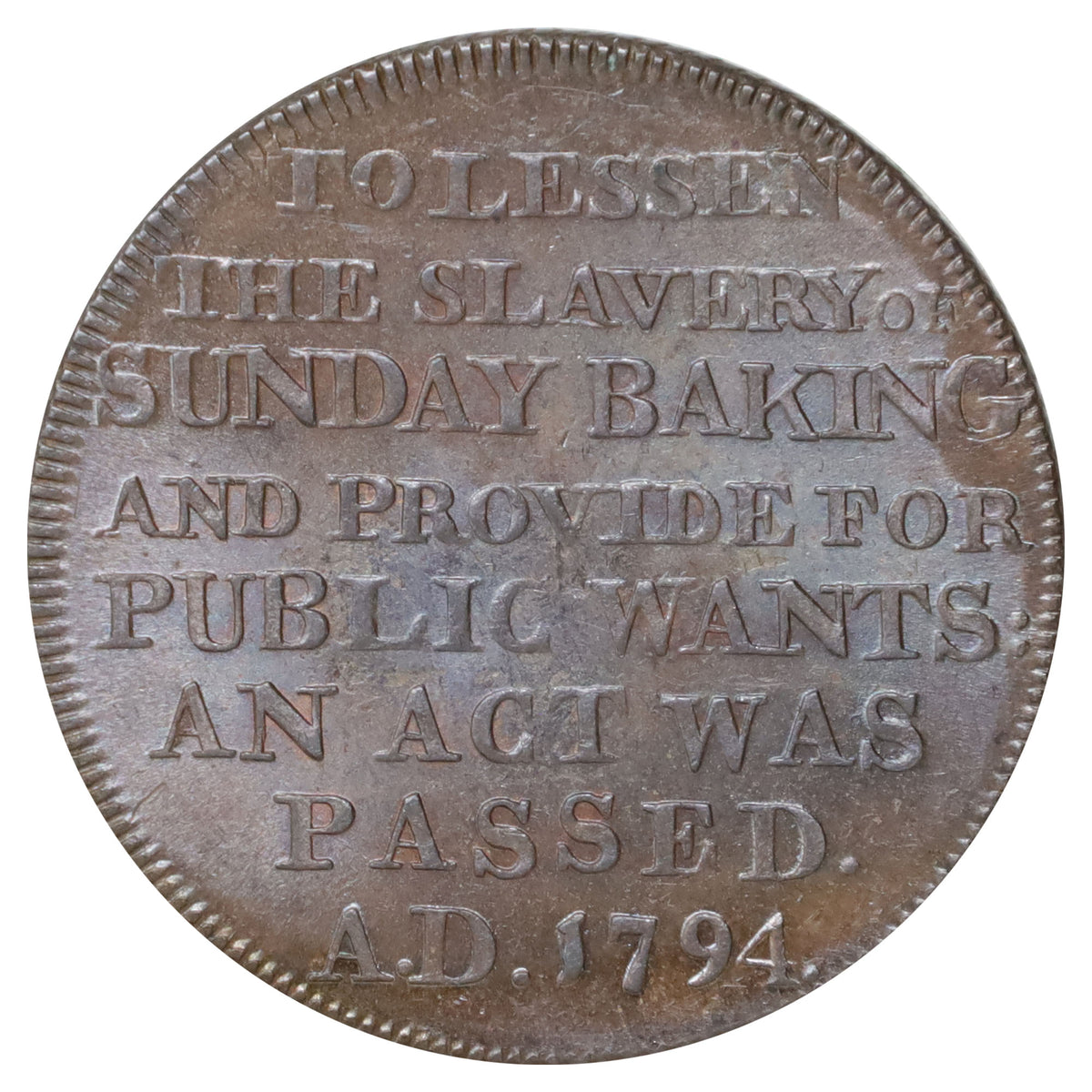
Reverse: The legend "TO LESSEN THE SLAVERY OF SUNDAY BAKING AND PROVIDE FOR PUBLIC WANTS: AN ACT WAS PASSED. A.D. 1794" on eight lines.
Specifications:
Composition: Copper
Diameter: 28mm
Edge: Reeded
Die Axis: ↑&darrl
On May 23, 1794, George III passed the Observance of the Lord's Day by Bakers Act 1794 (34 Geo. III c. 61). Despite its common nickname as the "No Baking on Sundays Act," it was not a complete prohibition on baking. Rather, it was intended to limit commercial baking activities on Sundays and encourage observance of the Christian Sabbath. Parliament argued that many bakers were exploiting existing exemptions for "works of necessity" and were effectively working throughout the day, depriving themselves and their employees of a day of rest. The Act prohibited bakers in London and the surrounding area from baking bread, rolls, pastries, meat pies, puddings, and similar goods on Sundays except under specifically permitted circumstances. Violators could be fined.
An interesting aspect of the Act is that it was presented not only as a religious measure but also as a labour reform. Eighteenth-century bakers often worked extremely long hours, much of it overnight, and supporters argued that the law would reduce what some contemporaries called the "slavery of Sunday baking." In fact, this commemorative token was struck in 1795 to celebrate the legislation for lessening Sunday labour among bakers. The law reflected broader British "Sunday observance" traditions that restricted many forms of commercial activity on the Lord's Day. Over time, however, these restrictions proved unpopular or impractical, and later legislation gradually relaxed the rules governing Sunday baking and bread sales.
For collectors and historians, the Act is a fascinating example of how late eighteenth-century Britain balanced religious values, public welfare, and labour concerns. While today it may sound like an unusual attempt to regulate baking, contemporaries viewed it as part of a larger effort to protect both the sanctity of Sunday and the wellbeing of workers in a physically demanding trade.
Obverse: A centralized wheatsheaf, with the legend around, and the date below.
Reverse: The legend "TO LESSEN THE SLAVERY OF SUNDAY BAKING AND PROVIDE FOR PUBLIC WANTS: AN ACT WAS PASSED. A.D. 1794" on eight lines.
Specifications:
Composition: Copper
Diameter: 28mm
Edge: Reeded
Die Axis: ↑&darrl