


Colonial Acres Coins
SKU: SKU:WC-6732
Transylvania 1728 Karl VI Siebenburgen Thaler Almost Uncirculated (AU50) $
Transylvania 1728 Karl VI Siebenburgen Thaler Almost Uncirculated (AU50) $
Regular price
$2,475.00
Regular price
$2,750.00
Sale price
$2,475.00
Unit price
per
We buy at $0.00
Shipping calculated at checkout.
◎ 1 Available
Couldn't load pickup availability

FREE SHIPPING OVER $500
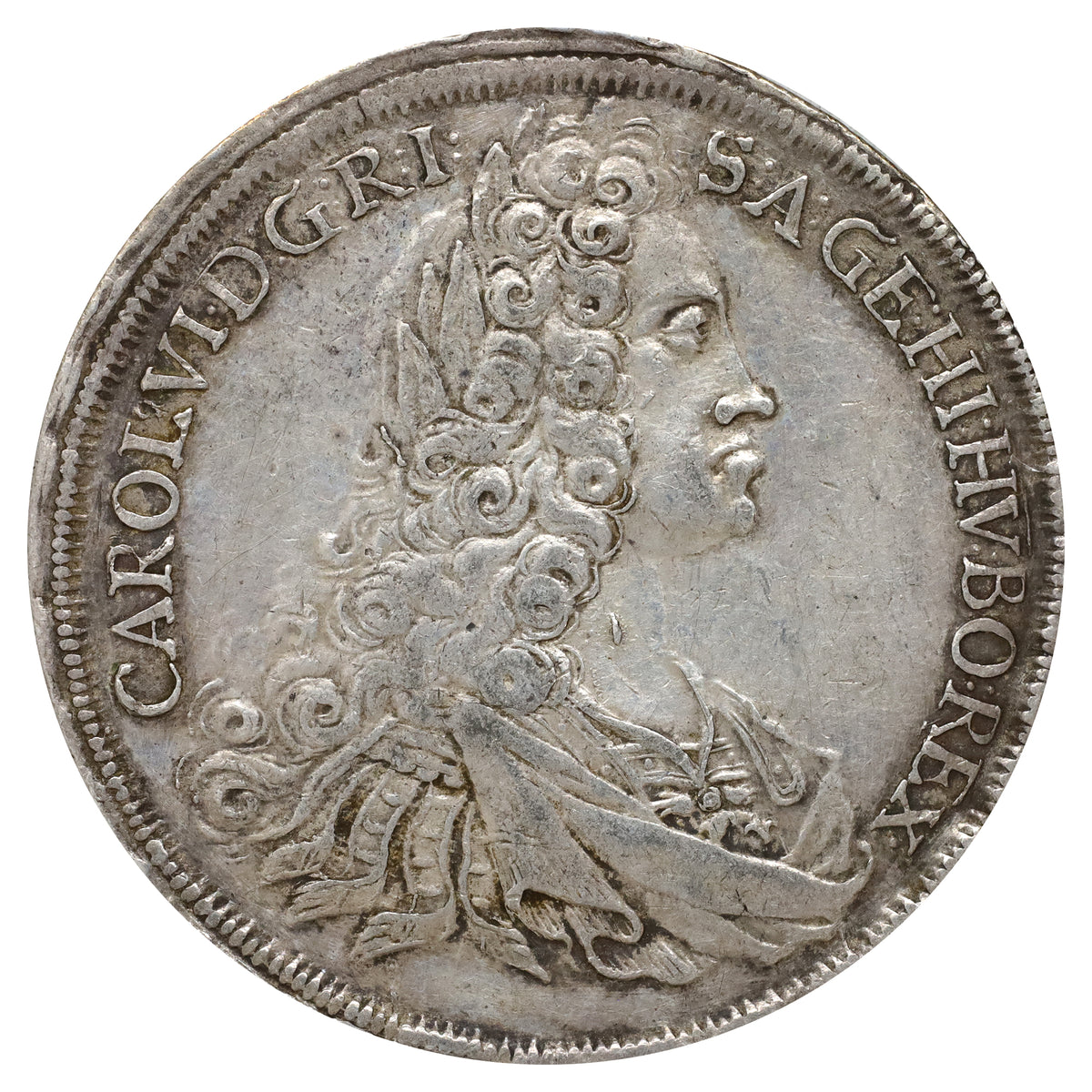
Transylvania 1728 Karl VI Siebenburgen Thaler Almost Uncirculated (AU50)
Charles VI, Holy Roman Emperor was a member of the House of Habsburg who ruled as Holy Roman Emperor from 1711 until his death in 1740, overseeing a vast and diverse collection of territories that included Austria, Hungary, and parts of Italy and the Low Countries. His reign followed the tumultuous War of the Spanish Succession, during which he had unsuccessfully sought the Spanish crown. As emperor, Charles VI focused on consolidating Habsburg authority and maintaining the balance of power in Europe, though his resources were often strained by ongoing military and diplomatic challenges.
He is perhaps best known for issuing the Pragmatic Sanction of 1713, a legal measure intended to ensure that his daughter, Maria Theresa, could inherit his territories in the absence of a male heir. Although many European powers initially recognized the arrangement, his death triggered the War of the Austrian Succession, as rival states contested Maria Theresa’s claims. Charles VI’s reign thus left a mixed legacy: he preserved Habsburg dominance in central Europe, but the fragile succession he engineered led to major conflict shortly after his death.
He exercised authority over Transylvania as part of the Habsburg Monarchy, consolidating control after the region had passed from Ottoman Empire influence in the late 17th century. During his reign, Transylvania was governed as a principality within the Habsburg domains, retaining certain traditional privileges of its estates while increasingly subjected to centralized imperial administration. Charles VI sought to strengthen Catholic influence in the region, promoting the Roman Catholic Church while also managing a diverse population that included Protestants and Eastern Christians. His policies aimed at tighter political integration and fiscal control, though these efforts sometimes created tension with local elites. Overall, his rule in Transylvania reflected the broader Habsburg approach of balancing regional autonomy with the demands of imperial centralization.
Obverse: Draped and laureate portrait of Karl VI, Holy Roman Emperor facing right, with the legend around.
Reverse: Crowned double-headed eagle with the Coat of Arms on its breast, surrounded by the chain of the Order of the Golden Fleece, with the date at 11 o'clock, and legend around.
Specifications:
Prince: Karl III (Karl VI, Holy Roman Emperor) (1711-1740)
Composition: Silver
Weight: 28.54 g
Diameter: 42 mm
Edge: Raised inscription
Die Axis: ↑↑
Charles VI, Holy Roman Emperor was a member of the House of Habsburg who ruled as Holy Roman Emperor from 1711 until his death in 1740, overseeing a vast and diverse collection of territories that included Austria, Hungary, and parts of Italy and the Low Countries. His reign followed the tumultuous War of the Spanish Succession, during which he had unsuccessfully sought the Spanish crown. As emperor, Charles VI focused on consolidating Habsburg authority and maintaining the balance of power in Europe, though his resources were often strained by ongoing military and diplomatic challenges.
He is perhaps best known for issuing the Pragmatic Sanction of 1713, a legal measure intended to ensure that his daughter, Maria Theresa, could inherit his territories in the absence of a male heir. Although many European powers initially recognized the arrangement, his death triggered the War of the Austrian Succession, as rival states contested Maria Theresa’s claims. Charles VI’s reign thus left a mixed legacy: he preserved Habsburg dominance in central Europe, but the fragile succession he engineered led to major conflict shortly after his death.
He exercised authority over Transylvania as part of the Habsburg Monarchy, consolidating control after the region had passed from Ottoman Empire influence in the late 17th century. During his reign, Transylvania was governed as a principality within the Habsburg domains, retaining certain traditional privileges of its estates while increasingly subjected to centralized imperial administration. Charles VI sought to strengthen Catholic influence in the region, promoting the Roman Catholic Church while also managing a diverse population that included Protestants and Eastern Christians. His policies aimed at tighter political integration and fiscal control, though these efforts sometimes created tension with local elites. Overall, his rule in Transylvania reflected the broader Habsburg approach of balancing regional autonomy with the demands of imperial centralization.
Obverse: Draped and laureate portrait of Karl VI, Holy Roman Emperor facing right, with the legend around.
Reverse: Crowned double-headed eagle with the Coat of Arms on its breast, surrounded by the chain of the Order of the Golden Fleece, with the date at 11 o'clock, and legend around.
Specifications:
Prince: Karl III (Karl VI, Holy Roman Emperor) (1711-1740)
Composition: Silver
Weight: 28.54 g
Diameter: 42 mm
Edge: Raised inscription
Die Axis: ↑↑