


Colonial Acres Coins
SKU: SKU:BT-0547
UC-2A1 (1824) Upper Canada Lesslie & Sons Half Penny Token VG-F (VG10)
UC-2A1 (1824) Upper Canada Lesslie & Sons Half Penny Token VG-F (VG10)
Regular price
$20.40
Regular price
$24.00
Sale price
$20.40
Unit price
per
We buy at $0.00
Shipping calculated at checkout.
◎ Not Available
Couldn't load pickup availability

FREE SHIPPING OVER $500
UC-2A1 (1824) Upper Canada Lesslie & Sons Half Penny Token VG-F (VG10)
James Lesslie (1802–1885) was a prominent Toronto bookseller, publisher, businessman, and Reform politician whose influence extended well beyond the family business of Lesslie & Sons. Born in Dundee, Scotland, he immigrated to Upper Canada in the early 1820s as part of his family's plan to establish a chain of bookstores and pharmacies in Kingston, York (later Toronto), and Dundas. After taking charge of the Toronto branch, Lesslie expanded the business into one of the city's best-known commercial enterprises, selling books, stationery, pharmaceuticals, and other imported goods. The firm is especially remembered by collectors for issuing the famous Lesslie & Sons merchant tokens of the 1820s and 1830s, which helped ease the chronic shortage of small change in Upper Canada and remain among the most iconic Canadian colonial tokens today.
Beyond his commercial success, Lesslie played an important role in the political and civic development of early Toronto. A close associate of William Lyon Mackenzie, he supported the Reform movement while advocating change through peaceful political means rather than armed rebellion. He helped establish the York Mechanics' Institute, the Bank of the People, and the Toronto House of Industry, institutions that promoted education, financial independence, and social welfare. Although he was arrested following the Rebellion of 1837, he was never convicted of participating in the uprising. Later in life, Lesslie served as a newspaper publisher, school trustee, and justice of the peace, leaving a lasting legacy as both a respected civic leader and one of the most influential businessmen in early Toronto.
Today, the Lesslie & Sons tokens are considered cornerstones of Canadian colonial numismatics. Their widespread circulation reflects the important role merchant tokens played in supporting commerce before an adequate supply of official currency became available. The 1822 Twopence token is particularly significant due to its larger denomination, making it one of the more unusual merchant-issued pieces of the period. Collectors prize both the Halfpenny and Twopence for their historical importance, attractive designs, and the variety of die combinations and conditions in which they survive. As tangible reminders of early Toronto's commercial growth and Canada's evolving monetary system, the Lesslie & Sons issues remain among the most desirable and recognizable merchant tokens in Canadian numismatic collections.
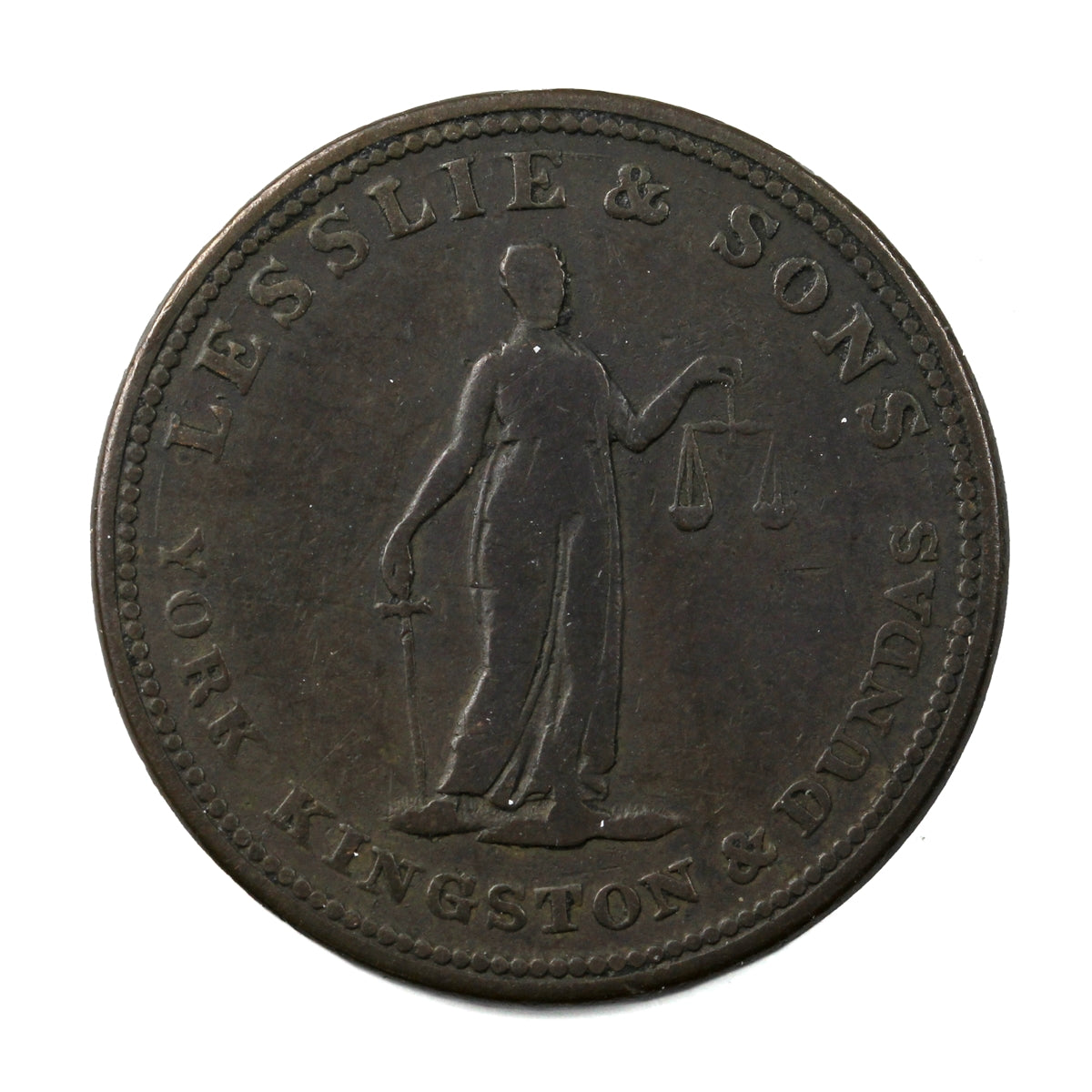
Obverse: Justice standing with scales in left hand an a sword in the right, with the legend around.
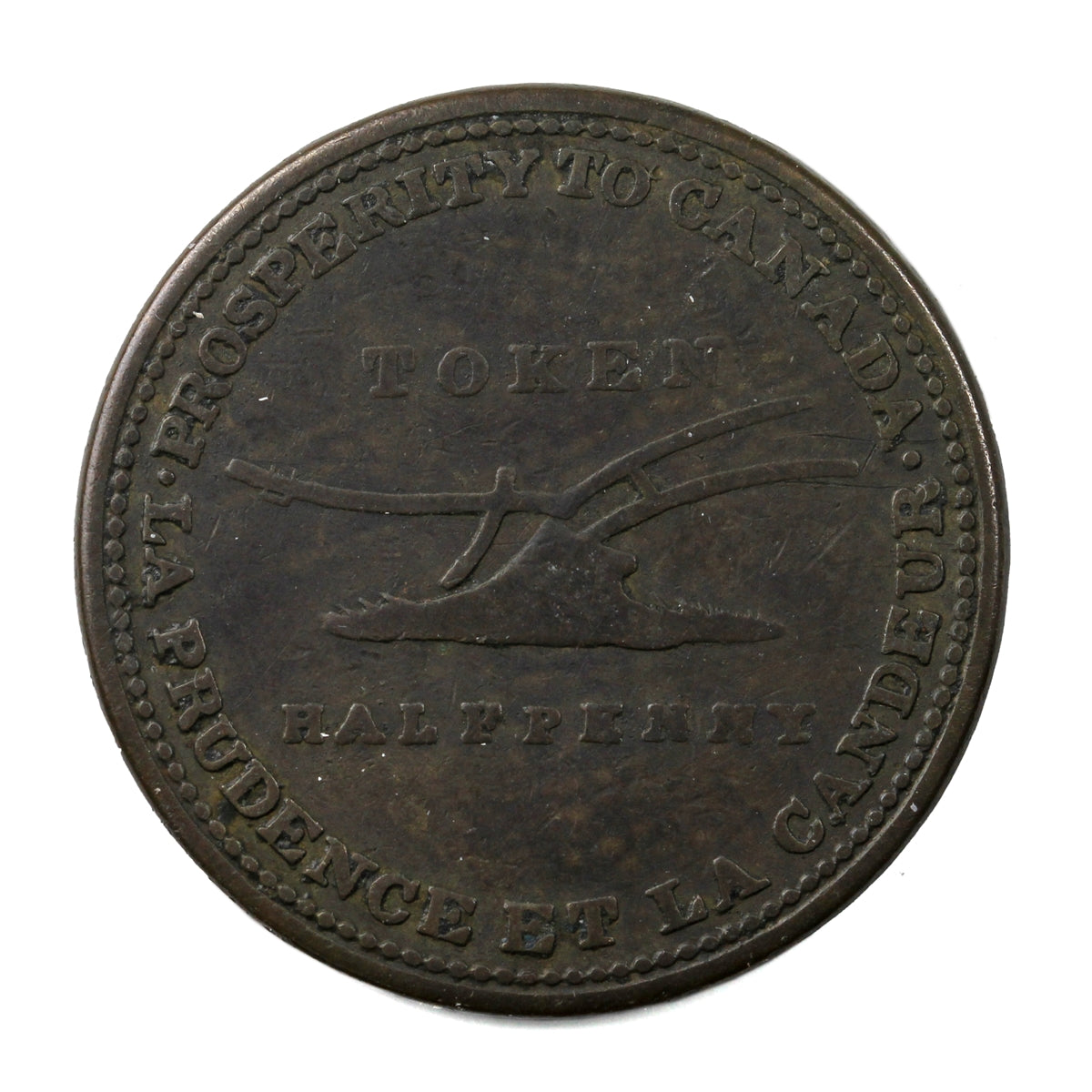
Reverse: A plough divides the denomination, with the legend around.
UC-2A1 Variety: There is no comma after York, the lower plough handle points to a period, the beam points to "P" of PROSPERITY, and the token has a plain edge.
Specifications:
Engraver: Thomas Wells Ingram
Composition: Copper
Weight: 7 g
Diameter: 27.5 mm
Edge: Plain
Die Axis: ↑↑
Mint: Soho Mint, Handsworth, United Kingdom