
Colonial Acres Coins
SKU: SKU:Nov.Week2.P1-KB3245
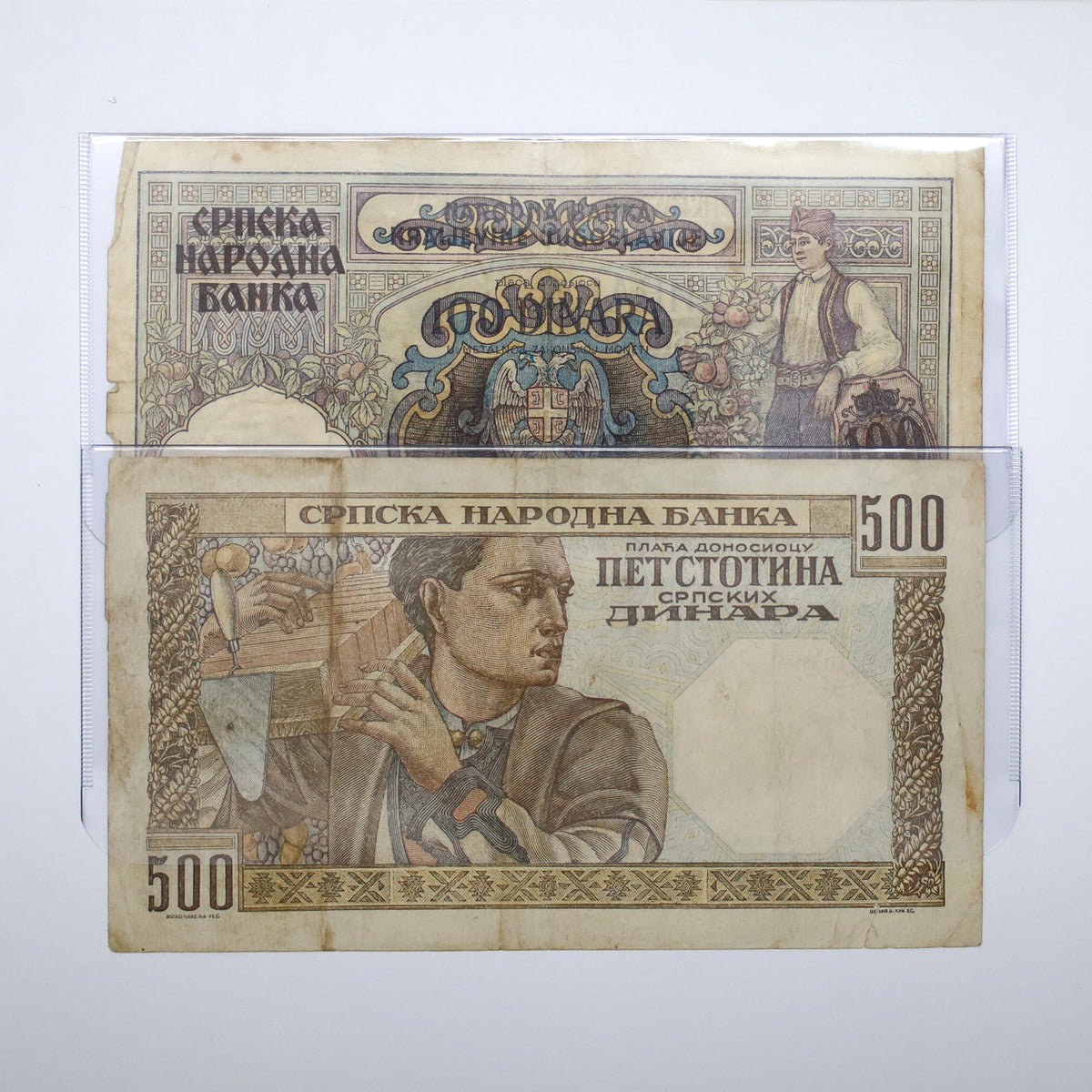
Pair of Serbia 1941 100 & 500 Dinara Banknotes, Circulated & Very Fine, 2pcs
Pair of Serbia 1941 100 & 500 Dinara Banknotes, Circulated & Very Fine, 2pcs
Regular price
$7.95
Regular price
$16.00
Sale price
$7.95
Unit price
per
We buy at $0.00
Shipping calculated at checkout.
◎ 1 Available
Couldn't load pickup availability

FREE SHIPPING OVER $500
Pair of Serbia 1941 100 & 500 Dinara Banknotes, Circulated & Very Fine, 2pcs
Serbia is a landlocked country in Southeast Europe, bordered by Hungary, Romania, Bulgaria, North Macedonia, Croatia, Bosnia and Herzegovina, and Montenegro. Most of it was divided into frontier provinces for the Roman Empire, a cushion against the hostile populations on the other side of the Danube River. Eventually, those hostile populations of mostly-Slavic peoples would settle the area, giving rise to the first Serbian proto-state around the 7th century CE. It reached its territorial apex in the Middle Ages as the Serbian Empire, but was later annexed by the Ottomans. Ottoman rule was ended violently in a series of rebellions between 1804 and 1835 that is together remembered as the Serbian Revolution. The final Ottoman withdrawal happened in 1867, establishing a constitutional monarchy in the new Kingdom of Serbia. Through the 20th century, it joined and separated from states around it until it became fully independent once more in 2006. In 2008, Kosovo declared its independence from Serbia -- though Serbia still regards it as part of its sovereign territory.
These Serbian banknotes from 1941 are rich with the country's history and culture. The 500 dinara note shows a woman in traditional dress and a bricklayer, with traditional artistic motifs. The 100 dinara note shows a traditionally costumed young man on the reverse, and a representation of Serbia on the obverse.