

Colonial Acres Coins
SKU: SKU:Nov.Week2.P1-KB3243
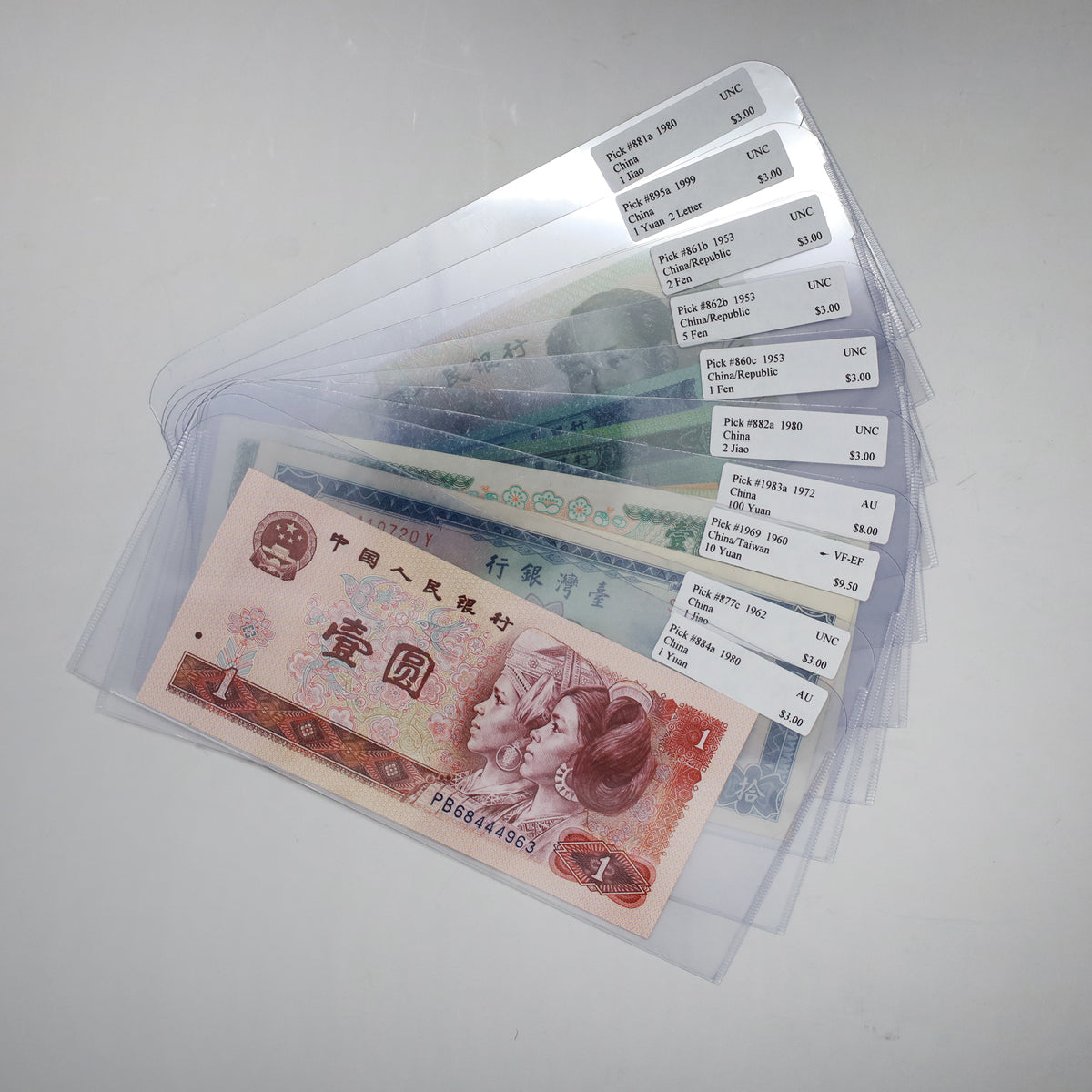
Lot of 10x China 1953-1999 Banknotes, VF-EF to UNC, 10pcs
Lot of 10x China 1953-1999 Banknotes, VF-EF to UNC, 10pcs
Regular price
$24.95
Regular price
$41.00
Sale price
$24.95
Unit price
per
We buy at $0.00
Shipping calculated at checkout.
◎ Not Available
Couldn't load pickup availability

FREE SHIPPING OVER $500
Lot of 10x China 1953-1999 Banknotes, VF-EF to UNC, 10pcs
In 1911, over two thousand years of imperial rule in China were abruptly brought to an end. There had been warning signs: throughout the 19th century, the people were growing increasingly weary of their ancient, hereditary monarchy, looking instead to the democratic republics that were springing up in Europe and beyond. The Qing imperial court, however, was too slow to react and too reluctant to reform. Revolts began in 1911 and culminated in the Wuchang Uprising, ousting the Qing entirely and fundamentally transforming China into Asia's first republic. The new republic was, in theory, based on the Three People's Principle of its first president, Sun Yat-sen: nationalism, democracy, and socialism. The new government would face significant challenges and eventually lost control of mainland China in a wildly destructive civil war to the Chinese Communist Party in 1949.
With the Republic thrown out, Communist Party leader Mao Zedong proclaimed the new People's Republic of China. The communists wanted to rebuild Chinese society from the ground up, and their reforms had absolutely cataclysmic consequences. Tens of millions of people were displaced or died in famines and purges during the 1958-1962 Great Leap Forward and the Cultural Revolution that followed. Intellectuals were persecuted; cultural heritage was destroyed; the economy crashed. It has been a long road for China as it rebuilds its identity and loosens some of its restrictions, but today it is poised as a global superpower with the world's second-largest economy.
This lot of banknotes is a testament to this tumultuous period in Chinese history. Dating from 1953 to 1999, they were in use during the Great Leap Forward, the Cultural Revolution, the modernization of the 1970s and 1980s, the acquisition of Hong Kong, and much more. Some represent the Republic of China in Taiwan. Some show Mao and communist imagery. One interesting one is the 1 yuan note from 1980 -- the two figures on the obverse are youths from the Dong and Yao cultures, peoples with elaborate courtship rituals that involve intricate, handmade costuming.