

Colonial Acres Coins
SKU: SKU:Nov.Week2.P1-KB3240
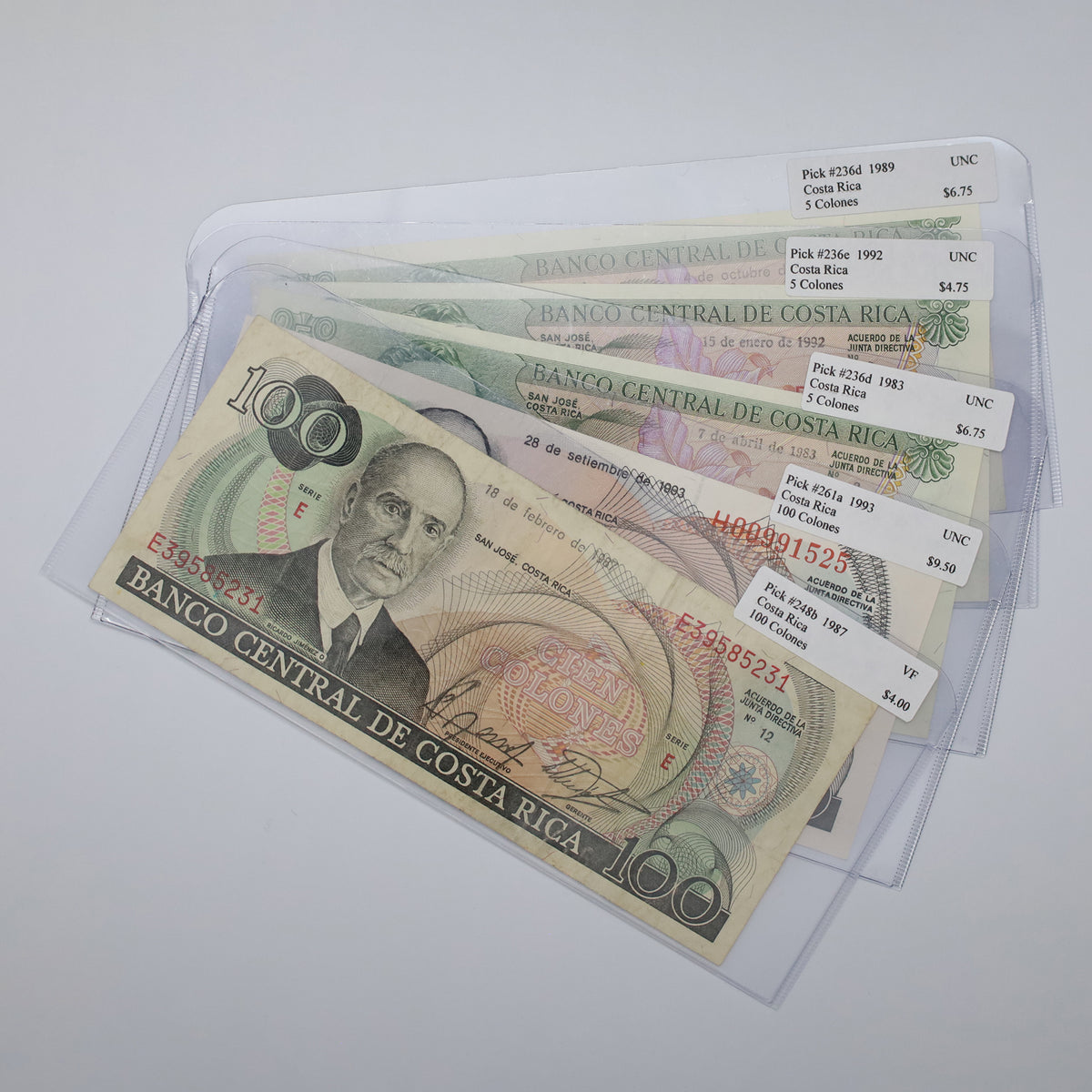
Lot of 5x Costa Rica 1983-1993 Banknotes, VF to UNC, 5pcs
Lot of 5x Costa Rica 1983-1993 Banknotes, VF to UNC, 5pcs
Regular price
$14.95
Regular price
$31.75
Sale price
$14.95
Unit price
per
We buy at $0.00
Shipping calculated at checkout.
◎ 1 Available
Couldn't load pickup availability

FREE SHIPPING OVER $500
Lot of 5x Costa Rica 1983-1993 Banknotes, VF to UNC, 5pcs
Tucked into the isthmus of Central America, Costa Rica overlooks the Pacific Ocean to the southwest and the Caribbean Sea to the northeast. Bordering Nicaragua and Panama, it is a tropical country renowned for its biodiversity -- its name literally translating to "Rich Coast." Humans have lived there for some 10,000 years, with the first signs of agriculture and pottery crafting appearing around 3000 BCE. Recorded history begins with the Spanish, who arrived in the early 16th century. Initially, the Spanish were tantalized by the vast amount of gold that the natives were apparently wearing, but they soon learned that Costa Rica has neither gold nor silver as a natural resource. They promptly lost interest. By the 18th century, Costa Rica was being described as the poorest and most miserable colony in the Spanish Americas. It gained independence suddenly and without violence in 1821, after the Spanish were defeated in the Mexican War of Independence. Eventually, the young country found its footing as an exporter of coffee -- an industry that surpasses all others in Costa Rica to this day.
Bring home a little piece of Costa Rica with this lot of banknotes from the 1980s and '90s. The 5-colones notes feature the portrait of Rafael Iglesias Castro, Costa Rica's president from 1894 to 1902, while the reverse shows Costa Ricans gathering coffee and bananas. The 100-colones note shows Ricardo Jiménez Oreamuno, who served as president multiple times from the 1910s through the 1930s.