

Colonial Acres Coins
SKU: SKU:Aug.Week5.P1-KB2490
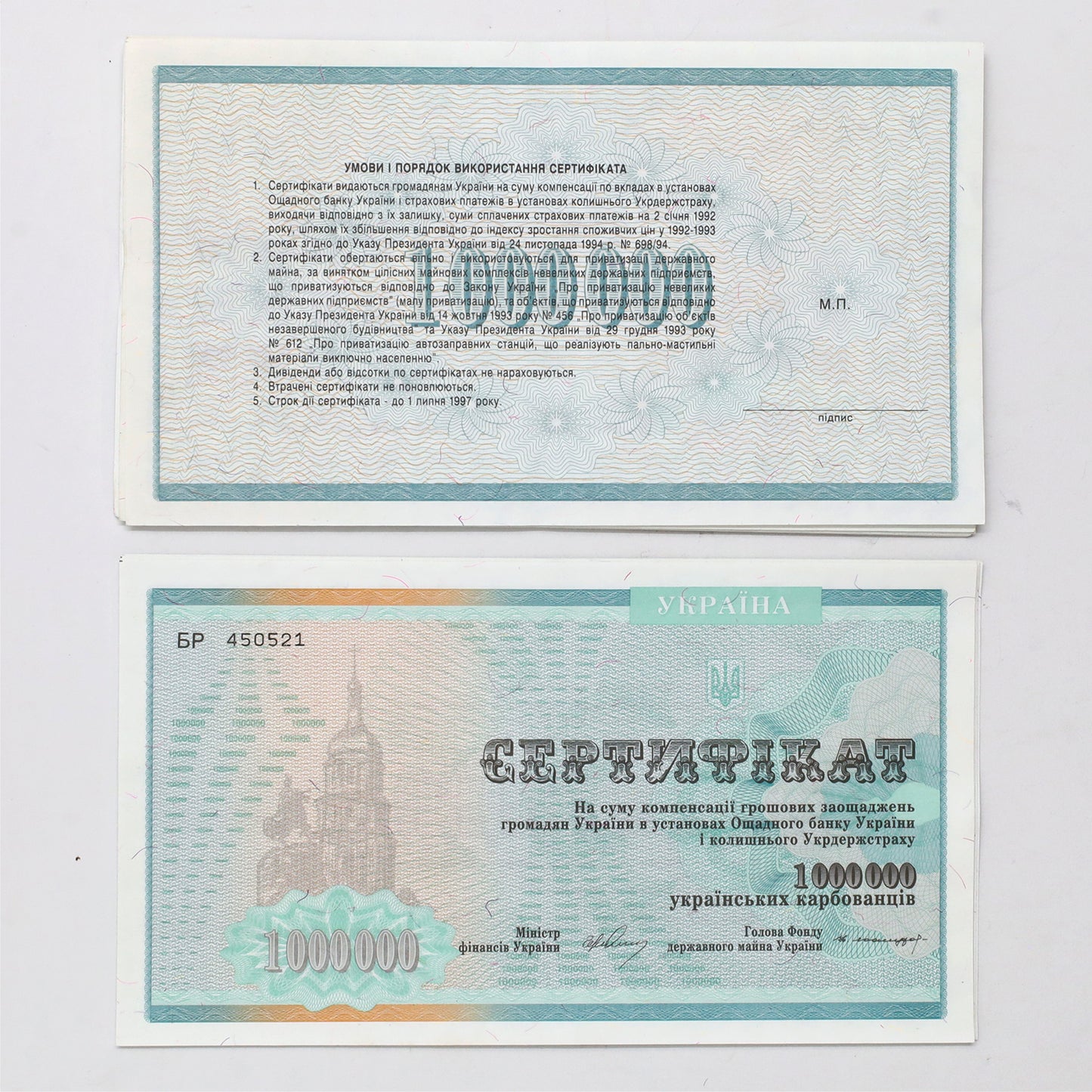
Lot of 24x Ukraine 1992 1,000,000 Karbovantsiv Banknotes, 24pcs
Lot of 24x Ukraine 1992 1,000,000 Karbovantsiv Banknotes, 24pcs
Regular price
$14.95
Regular price
Sale price
$14.95
Unit price
per
We buy at $0.00
Shipping calculated at checkout.
◎ Not Available
Couldn't load pickup availability

FREE SHIPPING OVER $500
Lot of 24x Ukraine 1992 1,000,000 Karbovantsiv Banknotes, 24pcs
The second-largest country in Europe, Ukraine borders Belarus, Poland, Slovakia, Hungary, Romania, Moldova, and, unfortunately, Russia. Likely the homeland of the domesticated horse, the area's early history is dominated by nomadic tribes of fearsome warriors who fought and, really, lived on horseback: the Scythians, the Cimmerians, and the Sarmatians among them. By the early Middle Ages, the area was a thoroughfare for Viking settlers in the north of Russia headed to and from the economic hub of Constantinople. A long trip -- and so, naturally, stops were required along the way. Even on a modern map, placing two fingers on Novgorod and Istanbul and pulling them together will point you directly at Kyiv -- Ukraine's capital. By the High Middle Ages, this little trading post was at the centre of a sprawling empire now referred to as Kyivan Rus'. Dominated by the descendants of those original Viking settlers and the local Slavs, called Rus' (probably meaning "rower" or "those who row"), its borders sprawled from the Barents to the Black Sea. Culturally, it was highly advanced; literacy was high, cathedrals soared, and laws were relatively progressive. Cracks, however, began showing in the twelfth century. Kyiv -- the city -- was highly desirable, and so feudal lords began wresting it from each other over and over again. Between 1146 and 1246, Kyiv changed hands forty-seven times. Weak from the repeated sieges, burnings, and ransackings, there was nothing the city could do when, in 1240, the Mongols came.
The Mongol invasion, led by Batu Khan, shattered Kyivan Rus'. From here, it was one disaster after another: Mongol oppression, war with Poland, conquest by Lithuania, the Black Death. Vicious Tatar slave raids stole upwards of two million people and sold them into the Ottoman Empire. Throughout the 17th and 18th centuries, most of the area was clawed into the Russian Empire, which saw (not entirely unjustifiably) the ancestral home of the Rus' as the heartland of their own people. But, of course, this came with oppression: an attempt to stamp out the Ukrainian language and Ukrainian identity as something distinct. By the dawn of the 19th century, Ukraine had had enough. A nationalist movement sprouted up and began gaining major traction as, throughout the World Wars, Ukrainians found themselves, yet again, at the centre of a tug-of-war between the powerful states surrounding them. When the Soviet Union toppled some fifty years later, Ukraine was finally able to declare its independence and become its own independent, fully-fledged state -- a status it continues to fight valiantly for today.
These early Ukrainian banknotes -- dating to the start of its independence in 1992 -- feature the silhouette of the Monastery of the Caves. Located in Kyiv, this soaring 15th-century monastery is a breathtaking example of Ukrainian Baroque architecture, and was a major centre of medieval printmaking.
The second-largest country in Europe, Ukraine borders Belarus, Poland, Slovakia, Hungary, Romania, Moldova, and, unfortunately, Russia. Likely the homeland of the domesticated horse, the area's early history is dominated by nomadic tribes of fearsome warriors who fought and, really, lived on horseback: the Scythians, the Cimmerians, and the Sarmatians among them. By the early Middle Ages, the area was a thoroughfare for Viking settlers in the north of Russia headed to and from the economic hub of Constantinople. A long trip -- and so, naturally, stops were required along the way. Even on a modern map, placing two fingers on Novgorod and Istanbul and pulling them together will point you directly at Kyiv -- Ukraine's capital. By the High Middle Ages, this little trading post was at the centre of a sprawling empire now referred to as Kyivan Rus'. Dominated by the descendants of those original Viking settlers and the local Slavs, called Rus' (probably meaning "rower" or "those who row"), its borders sprawled from the Barents to the Black Sea. Culturally, it was highly advanced; literacy was high, cathedrals soared, and laws were relatively progressive. Cracks, however, began showing in the twelfth century. Kyiv -- the city -- was highly desirable, and so feudal lords began wresting it from each other over and over again. Between 1146 and 1246, Kyiv changed hands forty-seven times. Weak from the repeated sieges, burnings, and ransackings, there was nothing the city could do when, in 1240, the Mongols came.
The Mongol invasion, led by Batu Khan, shattered Kyivan Rus'. From here, it was one disaster after another: Mongol oppression, war with Poland, conquest by Lithuania, the Black Death. Vicious Tatar slave raids stole upwards of two million people and sold them into the Ottoman Empire. Throughout the 17th and 18th centuries, most of the area was clawed into the Russian Empire, which saw (not entirely unjustifiably) the ancestral home of the Rus' as the heartland of their own people. But, of course, this came with oppression: an attempt to stamp out the Ukrainian language and Ukrainian identity as something distinct. By the dawn of the 19th century, Ukraine had had enough. A nationalist movement sprouted up and began gaining major traction as, throughout the World Wars, Ukrainians found themselves, yet again, at the centre of a tug-of-war between the powerful states surrounding them. When the Soviet Union toppled some fifty years later, Ukraine was finally able to declare its independence and become its own independent, fully-fledged state -- a status it continues to fight valiantly for today.
These early Ukrainian banknotes -- dating to the start of its independence in 1992 -- feature the silhouette of the Monastery of the Caves. Located in Kyiv, this soaring 15th-century monastery is a breathtaking example of Ukrainian Baroque architecture, and was a major centre of medieval printmaking.