

Colonial Acres Coins
SKU: SKU:Aug.Week5.P1-KB2489
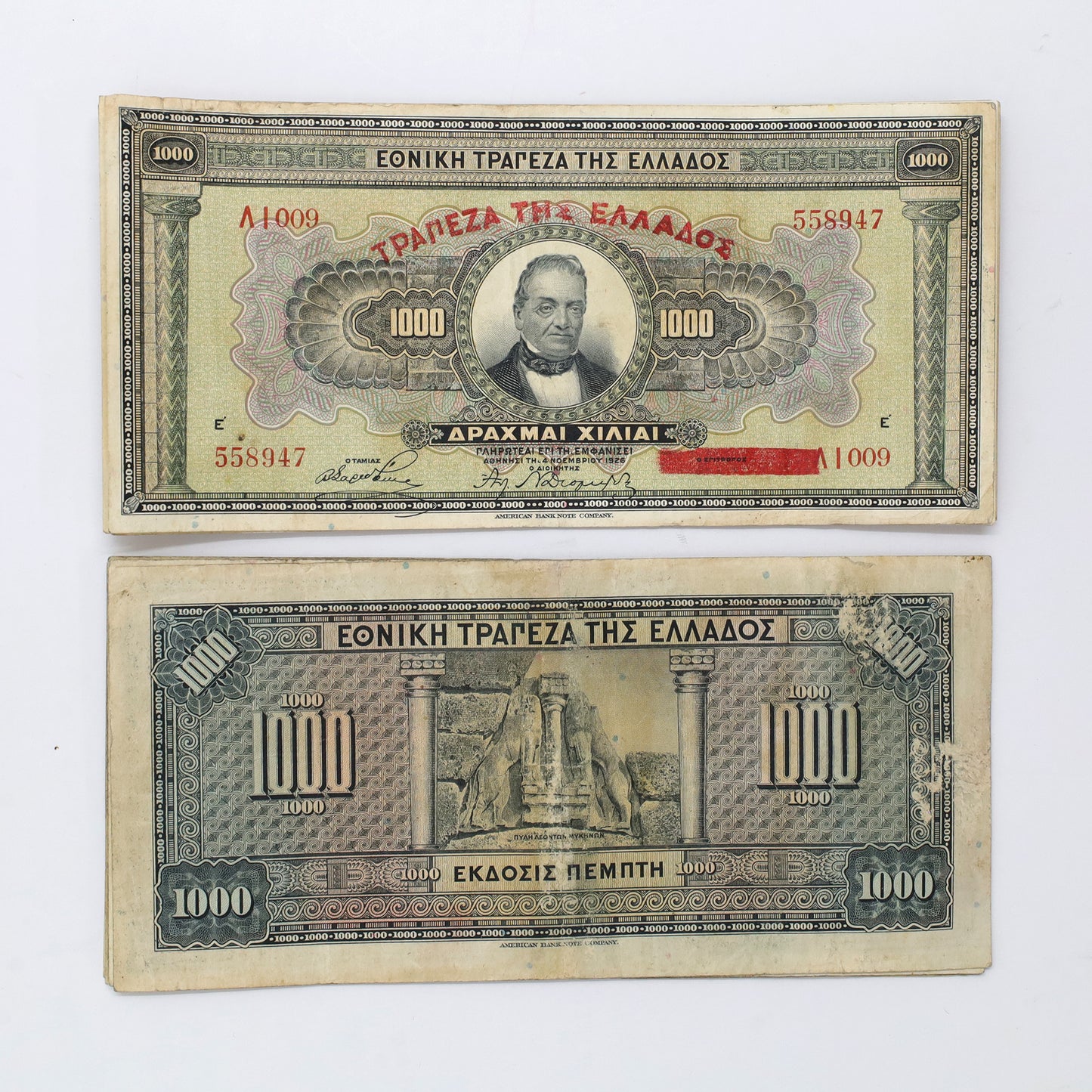
Lot of 10x Greece 1926 1000 Drachmai Banknotes, 10pcs
Lot of 10x Greece 1926 1000 Drachmai Banknotes, 10pcs
Regular price
$14.95
Regular price
Sale price
$14.95
Unit price
per
We buy at $0.00
Shipping calculated at checkout.
◎ 1 Available
Couldn't load pickup availability

FREE SHIPPING OVER $500
Lot of 10x Greece 1926 1000 Drachmai Banknotes, 10pcs
Dipping from the Balkans into the Mediterranean, Greece is bordered by North Macedonia, Albania, and Bulgaria, and shares maritime borders with Italy across the Ionian Sea and Türkiye across the Aegean. If there is one wellspring of Western civilization, it must be Greece, whose ancient philosophy, arts, literature, architecture, scientific and mathematical principles, mythography, athletics, and political theory all continue to dominate modern Western thought, practice, values, and culture. To this day, nations compete in the Olympic Games, doctors swear the Hippocratic Oath, mathematicians use the Pythagorean theorem, architects copy the Parthenon to convey prestige, students are taught Aristotelian logic, and dramatizations of Greek myths pull massive audiences. About 10% of the English language comes from Greek -- if you've bought an antique, used a telephone, consulted an encyclopedia, or participated in the economy, you've engaged with Greek language.
In the 2nd century BCE, the growing Roman Republic annexed Greece -- but the conquered's influence over the conqueror was so profound that, as one Roman poet put it, “Captive Greece took captive her savage conquerer and brought the arts to rustic Latium." Perhaps this union was most strongly manifested in the Byzantine Empire, a Greek-speaking Roman successor state that dominated Eastern Europe throughout late antiquity and into the Middle Ages. To the Byzantines, Greece was a heartland. After Constantinople, Thessaloniki was the Empire's largest city, considered by many to be a secondary capital. In 1453, the Byzantine Empire was conquered by the Ottomans, and so Greece came under Turkish rule. This lasted until 1830, when Greece finally broke free of Ottoman control. What followed was over a century of unrest, as Greece tussled with the Balkan states to the North, endured a dictatorship, suffered military occupation, and fought a civil war. Today, however, it enjoys a high standard of living and is, understandably, one of the most visited countries in the world.
These 1926 banknotes date to shortly after the Greco-Turkish War, when Greek aspirations for territorial expansion had been largely squashed, and its monarchy toppled. The obverse features Georgios Stavros, founder of the National Bank of Greece. The structure on the reverse is the relief above the lintel at Mycenae, a Bronze Age citadel tied to the heroic age of the epics of Homer.
Dipping from the Balkans into the Mediterranean, Greece is bordered by North Macedonia, Albania, and Bulgaria, and shares maritime borders with Italy across the Ionian Sea and Türkiye across the Aegean. If there is one wellspring of Western civilization, it must be Greece, whose ancient philosophy, arts, literature, architecture, scientific and mathematical principles, mythography, athletics, and political theory all continue to dominate modern Western thought, practice, values, and culture. To this day, nations compete in the Olympic Games, doctors swear the Hippocratic Oath, mathematicians use the Pythagorean theorem, architects copy the Parthenon to convey prestige, students are taught Aristotelian logic, and dramatizations of Greek myths pull massive audiences. About 10% of the English language comes from Greek -- if you've bought an antique, used a telephone, consulted an encyclopedia, or participated in the economy, you've engaged with Greek language.
In the 2nd century BCE, the growing Roman Republic annexed Greece -- but the conquered's influence over the conqueror was so profound that, as one Roman poet put it, “Captive Greece took captive her savage conquerer and brought the arts to rustic Latium." Perhaps this union was most strongly manifested in the Byzantine Empire, a Greek-speaking Roman successor state that dominated Eastern Europe throughout late antiquity and into the Middle Ages. To the Byzantines, Greece was a heartland. After Constantinople, Thessaloniki was the Empire's largest city, considered by many to be a secondary capital. In 1453, the Byzantine Empire was conquered by the Ottomans, and so Greece came under Turkish rule. This lasted until 1830, when Greece finally broke free of Ottoman control. What followed was over a century of unrest, as Greece tussled with the Balkan states to the North, endured a dictatorship, suffered military occupation, and fought a civil war. Today, however, it enjoys a high standard of living and is, understandably, one of the most visited countries in the world.
These 1926 banknotes date to shortly after the Greco-Turkish War, when Greek aspirations for territorial expansion had been largely squashed, and its monarchy toppled. The obverse features Georgios Stavros, founder of the National Bank of Greece. The structure on the reverse is the relief above the lintel at Mycenae, a Bronze Age citadel tied to the heroic age of the epics of Homer.