

Colonial Acres Coins
SKU: SKU:Aug.Week5.P1-KB2488
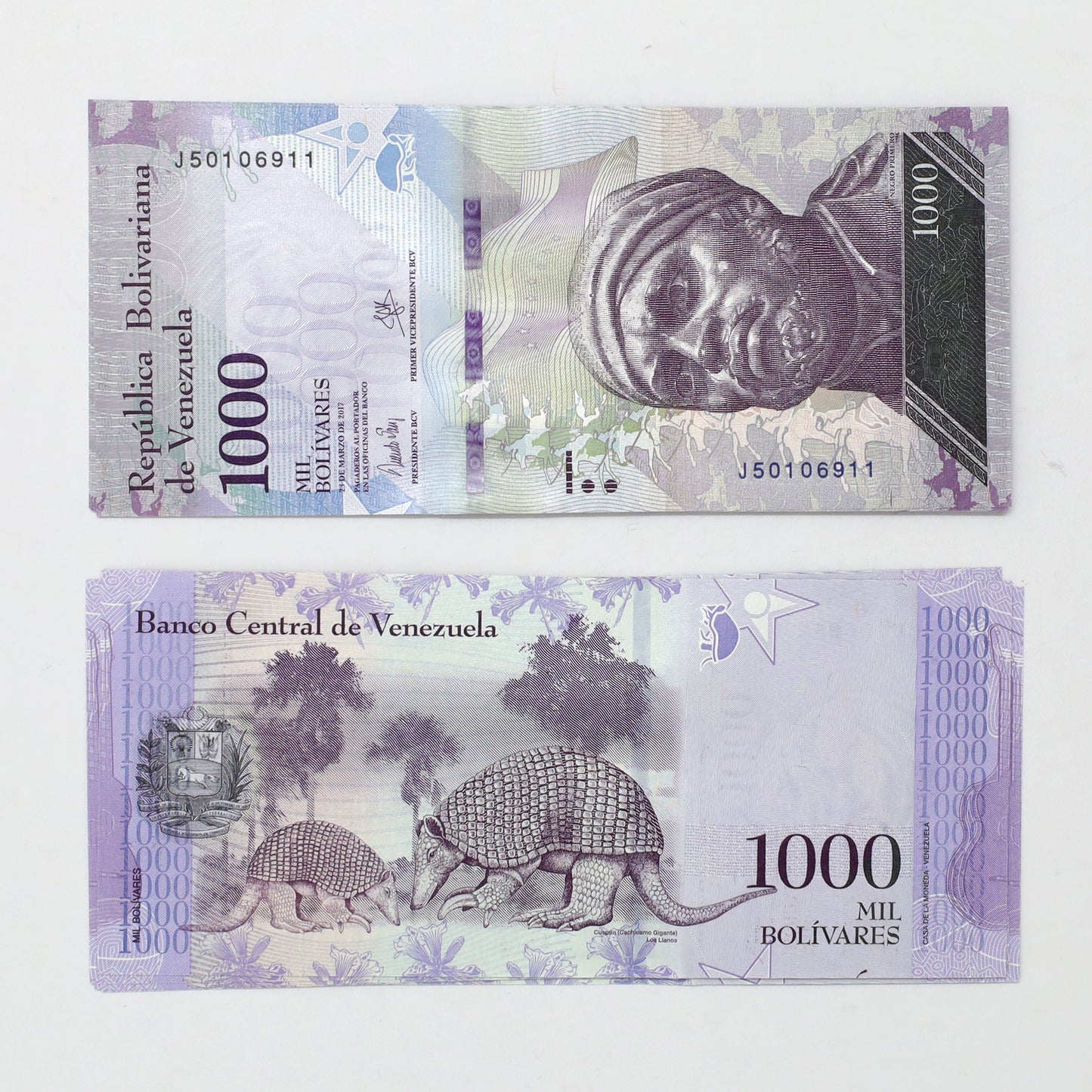
Lot of 10x Venezuela 2017 1000 Bolivares Banknotes, 10pcs
Lot of 10x Venezuela 2017 1000 Bolivares Banknotes, 10pcs
Regular price
$14.95
Regular price
Sale price
$14.95
Unit price
per
We buy at $0.00
Shipping calculated at checkout.
◎ Not Available
Couldn't load pickup availability

FREE SHIPPING OVER $500
Lot of 10x Venezuela 2017 1000 Bolivares Banknotes, 10pcs
Located on the northern coast of South America, Venezuela borders Colombia, Brazil, Guyana, and Trinidad and Tobago. When Spanish conquistador Alonso de Ojeda first encountered the beautiful coast in 1499, he named it "Little Venice" because the stilt houses inhabited by the local indigenous people reminded him and his crew of one of Europe's most exquisite cities. The area became a Spanish colony in 1522 with the establishment of modern Cumaná, and rumours of the vast riches of the Venezuelan interior, such as El Dorado, the Golden Man, made exploratory efforts especially aggressive. Relations between the European settlers and indigenous population were fraught with violence, and the spread of disease -- foreign, to the Indigenous, and tropical, to the colonists -- made the area especially perilous. Still, the colonial machine chugged on, and both Indigenous and imported Black African slaves were made to toil on expansive plantations. The colonial period ended with the rise of Simón Bolívar, a Creole landowner who held Enlightenment ideals -- truth, reason, liberty, and the universality of human rights -- and wanted badly to end Spanish rule over South America. When Napoleon had Spain distracted, Bolívar leapt into the fight for independence. He fought the Royalists fiercely, defeating the Spanish in New Granada, Venezuela, Panama, Ecuador, Peru, and Bolivia. He is widely regarded as a hero and a cultural icon to this day, and the nations of Bolivia and Venezuela (as the Bolivarian Republic of Venezuela) are named after him.
This 1000 bolivares (named for Bolívar) depicts a pair of armadillos on the reverse. The man on the obverse is Pedro Camejo, also known as Negro Primero (literally "The First Black"). Born into slavery, this Afro-Venezuelan war hero served as a lancer and, later, a lieutnenant in Bolívar's army. His nickname is a reference to his bravery -- as Camejo was known for always being on the front line, one of the first to charge into battle.
Located on the northern coast of South America, Venezuela borders Colombia, Brazil, Guyana, and Trinidad and Tobago. When Spanish conquistador Alonso de Ojeda first encountered the beautiful coast in 1499, he named it "Little Venice" because the stilt houses inhabited by the local indigenous people reminded him and his crew of one of Europe's most exquisite cities. The area became a Spanish colony in 1522 with the establishment of modern Cumaná, and rumours of the vast riches of the Venezuelan interior, such as El Dorado, the Golden Man, made exploratory efforts especially aggressive. Relations between the European settlers and indigenous population were fraught with violence, and the spread of disease -- foreign, to the Indigenous, and tropical, to the colonists -- made the area especially perilous. Still, the colonial machine chugged on, and both Indigenous and imported Black African slaves were made to toil on expansive plantations. The colonial period ended with the rise of Simón Bolívar, a Creole landowner who held Enlightenment ideals -- truth, reason, liberty, and the universality of human rights -- and wanted badly to end Spanish rule over South America. When Napoleon had Spain distracted, Bolívar leapt into the fight for independence. He fought the Royalists fiercely, defeating the Spanish in New Granada, Venezuela, Panama, Ecuador, Peru, and Bolivia. He is widely regarded as a hero and a cultural icon to this day, and the nations of Bolivia and Venezuela (as the Bolivarian Republic of Venezuela) are named after him.
This 1000 bolivares (named for Bolívar) depicts a pair of armadillos on the reverse. The man on the obverse is Pedro Camejo, also known as Negro Primero (literally "The First Black"). Born into slavery, this Afro-Venezuelan war hero served as a lancer and, later, a lieutnenant in Bolívar's army. His nickname is a reference to his bravery -- as Camejo was known for always being on the front line, one of the first to charge into battle.