


Colonial Acres Coins
SKU: SKU:Aug.Week2.P3-KB1631
Ancient Rome 286-310 AD Maximianus Bronze Coin
Ancient Rome 286-310 AD Maximianus Bronze Coin
Regular price
$28.45
Regular price
Sale price
$28.45
Unit price
per
We buy at $0.00
Shipping calculated at checkout.
◎ 1 Available
Couldn't load pickup availability

FREE SHIPPING OVER $500
Ancient Rome 286-310 AD Maximianus Bronze Coin
When Diocletian took the purple in 284, he was at the tail end of a period that historians now call the Crisis of the Third Century. He recognized that the empire's core problem was that it had grown too large and its problems too complex for one-man rule, and made the hard choice to give up power in exchange for stability. This was the birth of the Tetrarchy (literally "rule of four"), which saw Diocletian split the empire into quarters and assign himself three junior co-emperors. With a smaller area and more localized problems to focus on, each co-emperor could rule and defend more effectively and, therefore, contribute to a stronger and more stable whole The most senior of these co-emperors was Maximianus, known better as Maximian.
Maximian and Diocletian -- who was still, practically speaking, his boss -- were what was called augusti, or senior emperors. The other two, Galerius and Constantius, were caesares, or junior emperors. They were younger, and would take over as augusti when the senior pair retired. It actually worked fairly well for a while, and Maximian managed to stabilize Western Europe and North Africa while Diocletian focused on the east. In 303, according to plan, Diocletian and Maximian stepped down to make way for the new generation. Then, everything went pear-shaped.
It was assumed that when Galerius and Constantius ascended, one of the two new vacancies for caesares would go to Maximian's son, Maxentius. The other would go to Constantius' son, Constantine. They did not. Instead both positions went to people associated with Galerius -- his friend, Severus, and his nephew, Maximinus. When Constantius died suddenly, Severus moved into his spot and Constantine got the junior position, effectively icing out Maxentius. Maxentius took it badly. He raised an army and declared himself augustus. Then, he mailed a set of imperial robes to his poor, retired dad on his hobby farm in southern Italy and named him his co-emperor. Maximian, apparently a supportive parent even in times of imperial insurgency, got back in the game.
Rome quickly descended back into the trainwreck of strife and civil war that had defined it up until Diocletian (who lived to see all his hard work undone). Maximian and Maxentius became the key rivals of Constantine, who would eventually capture the former and force him to commit suicide, and defeat the latter at the Battle of Milvian Bridge. Constantine, later dubbed "the Great," would return Rome to single-man rule, ending the wild --- but effective -- experiment that had been the Tetrarchy.
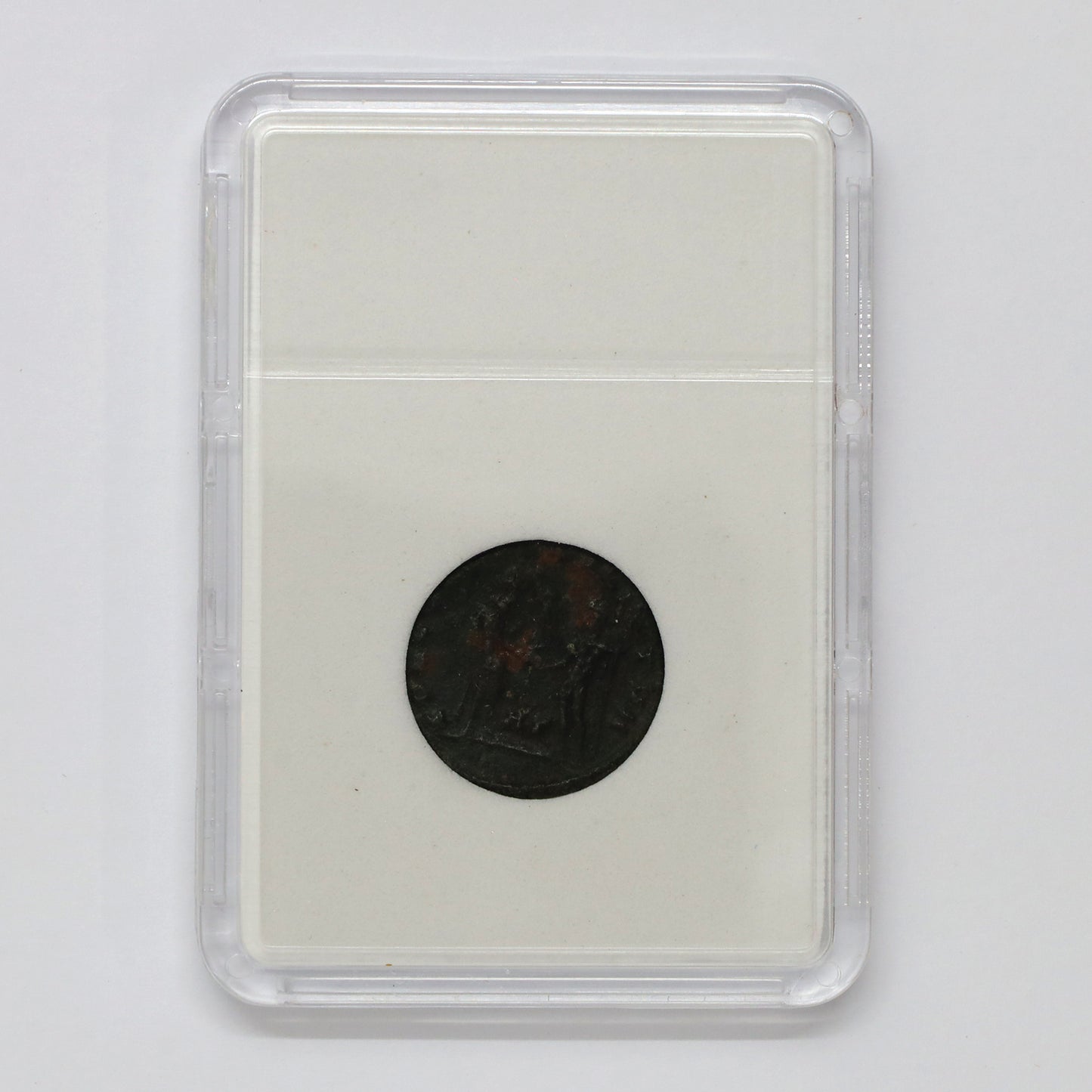
Now you can own a piece one of Rome's greatest political experiments and most tumultuous periods. This bronze coin features the bust of Maximian, radiate and cuirassed, on the obverse. The reverse depicts Jupiter, king of the gods, handing the goddess Victoria (Victory) standing atop a globe to Maximian, with his hands outstretched.
When Diocletian took the purple in 284, he was at the tail end of a period that historians now call the Crisis of the Third Century. He recognized that the empire's core problem was that it had grown too large and its problems too complex for one-man rule, and made the hard choice to give up power in exchange for stability. This was the birth of the Tetrarchy (literally "rule of four"), which saw Diocletian split the empire into quarters and assign himself three junior co-emperors. With a smaller area and more localized problems to focus on, each co-emperor could rule and defend more effectively and, therefore, contribute to a stronger and more stable whole The most senior of these co-emperors was Maximianus, known better as Maximian.
Maximian and Diocletian -- who was still, practically speaking, his boss -- were what was called augusti, or senior emperors. The other two, Galerius and Constantius, were caesares, or junior emperors. They were younger, and would take over as augusti when the senior pair retired. It actually worked fairly well for a while, and Maximian managed to stabilize Western Europe and North Africa while Diocletian focused on the east. In 303, according to plan, Diocletian and Maximian stepped down to make way for the new generation. Then, everything went pear-shaped.
It was assumed that when Galerius and Constantius ascended, one of the two new vacancies for caesares would go to Maximian's son, Maxentius. The other would go to Constantius' son, Constantine. They did not. Instead both positions went to people associated with Galerius -- his friend, Severus, and his nephew, Maximinus. When Constantius died suddenly, Severus moved into his spot and Constantine got the junior position, effectively icing out Maxentius. Maxentius took it badly. He raised an army and declared himself augustus. Then, he mailed a set of imperial robes to his poor, retired dad on his hobby farm in southern Italy and named him his co-emperor. Maximian, apparently a supportive parent even in times of imperial insurgency, got back in the game.
Rome quickly descended back into the trainwreck of strife and civil war that had defined it up until Diocletian (who lived to see all his hard work undone). Maximian and Maxentius became the key rivals of Constantine, who would eventually capture the former and force him to commit suicide, and defeat the latter at the Battle of Milvian Bridge. Constantine, later dubbed "the Great," would return Rome to single-man rule, ending the wild --- but effective -- experiment that had been the Tetrarchy.
Now you can own a piece one of Rome's greatest political experiments and most tumultuous periods. This bronze coin features the bust of Maximian, radiate and cuirassed, on the obverse. The reverse depicts Jupiter, king of the gods, handing the goddess Victoria (Victory) standing atop a globe to Maximian, with his hands outstretched.