

Colonial Acres Coins
SKU: SKU:July.Week3.P1-KB2039
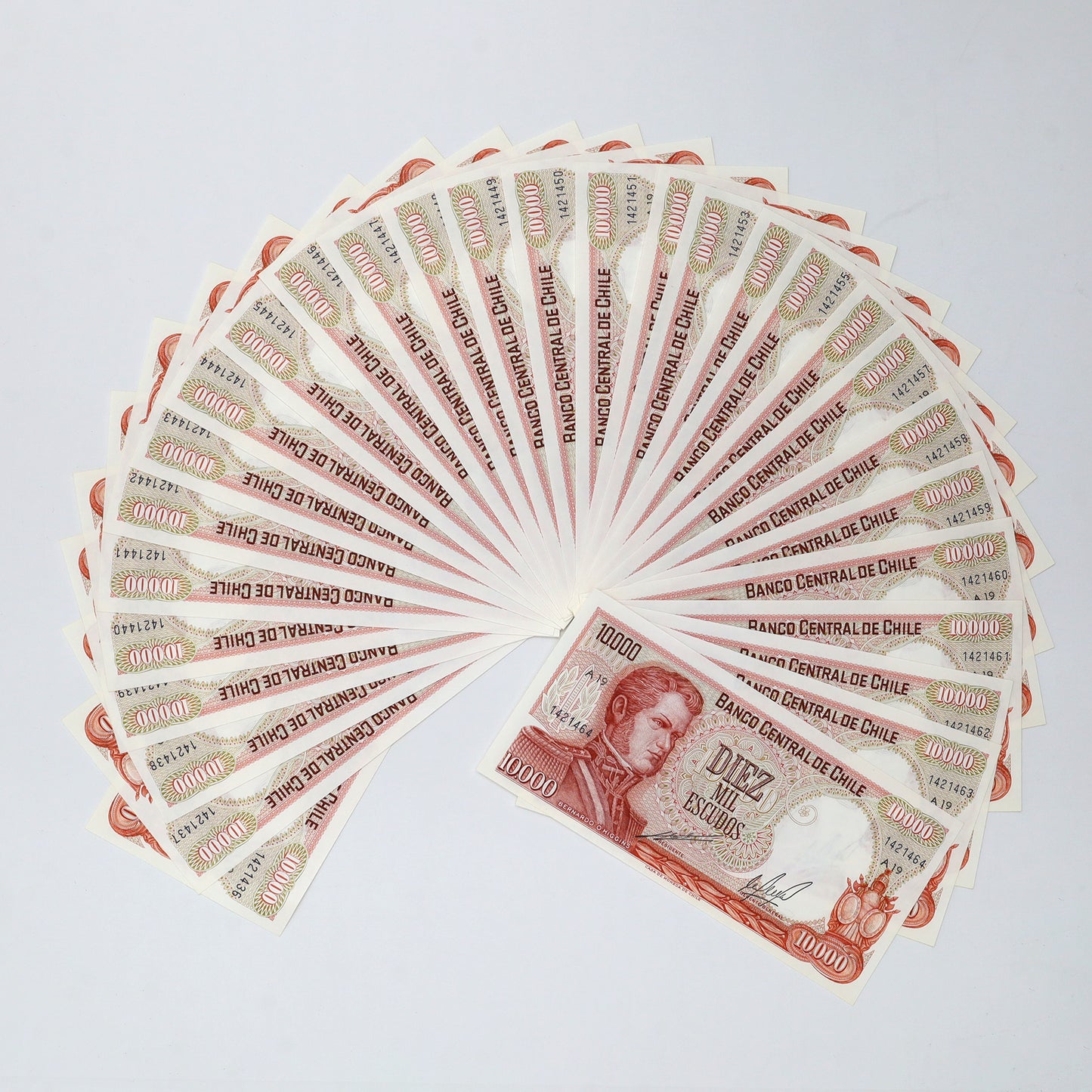
Lot of 29x Sequential Chile 1974 10,000 Escudos Banknotes, 29pcs
Lot of 29x Sequential Chile 1974 10,000 Escudos Banknotes, 29pcs
Regular price
$34.95
Regular price
Sale price
$34.95
Unit price
per
We buy at $0.00
Shipping calculated at checkout.
◎ Not Available
Couldn't load pickup availability

FREE SHIPPING OVER $500
Lot of 29x Sequential Chile 1974 10,000 Escudos Banknotes, 29pcs
Chile is a narrow, coastal country that occupies the space between the Andes Mountains and the Pacific Ocean, bordered by Peru, Bolivia, and Argentina. Settlement began about 10,000 years ago, and the area was soon occupied by the Mapuche. The Mapuche, who remain Chile's largest Indigenous group today, fought valiantly to defend their land against invaders: first, against the Inca, whose imperial ambitions began creeping into northern Chile in the late 15th century; then, against the Spanish, whose conquest of the area began in 1540. Isolated by geography and Mapuche resistance, Spanish settlement in Chile was a bit of a rough, frontier affair that mostly served as a buffer between Spain's enemies and her other colonies. Movement for independence began in the early 19th century, and the struggle between Chilean revolutionaries and Spanish authority continued until 1818, when the Spanish were decisively defeated at the Battle of Maipú.
This 10,000 escudos note dates to 1974. The portrait on the obverse is of founding father and independence leader Bernardo O'Higgins. The reverse depicts the 1814 Battle of Rancagua, based on the 1938 painting O'Higgins' Charge at the Battle of Rancagua by Pedro Subercaseaux.
Chile is a narrow, coastal country that occupies the space between the Andes Mountains and the Pacific Ocean, bordered by Peru, Bolivia, and Argentina. Settlement began about 10,000 years ago, and the area was soon occupied by the Mapuche. The Mapuche, who remain Chile's largest Indigenous group today, fought valiantly to defend their land against invaders: first, against the Inca, whose imperial ambitions began creeping into northern Chile in the late 15th century; then, against the Spanish, whose conquest of the area began in 1540. Isolated by geography and Mapuche resistance, Spanish settlement in Chile was a bit of a rough, frontier affair that mostly served as a buffer between Spain's enemies and her other colonies. Movement for independence began in the early 19th century, and the struggle between Chilean revolutionaries and Spanish authority continued until 1818, when the Spanish were decisively defeated at the Battle of Maipú.
This 10,000 escudos note dates to 1974. The portrait on the obverse is of founding father and independence leader Bernardo O'Higgins. The reverse depicts the 1814 Battle of Rancagua, based on the 1938 painting O'Higgins' Charge at the Battle of Rancagua by Pedro Subercaseaux.