


Colonial Acres Coins
SKU: SKU:Sept.Week2.P3-KB1896
Bundle of 100x Croatia 1993 100,000 Dinara Consecutive Notes (tears)
Bundle of 100x Croatia 1993 100,000 Dinara Consecutive Notes (tears)
Regular price
$94.00
Regular price
Sale price
$94.00
Unit price
per
We buy at $0.00
Shipping calculated at checkout.
◎ 1 Available
Couldn't load pickup availability

FREE SHIPPING OVER $500
(Bundle of 100) Croatia 1993 100,000 Dinara Consecutive Notes (tears)
The Republic of Croatia borders Slovenia, Hungary, and Serbia on the coast of the Adriatic Sea. The original Croats arrived in the late 6th century, when the area was still largely referred to by the Classical name of Illyria. It became an independent kingdom in 925 with the coronation of Tomislav, but the continuous threat of the Ottoman Empire and rivalry with the Republic of Venice saw it join with the Habsburg monarchy in 1527. It remained tightly bound to Austria and Hungary until after World War I, when it became part of Yugoslavia, before finally declaring its independence in 1991. A fierce War of Independence began, and the new state of Croatia was officially recognized in 1992.
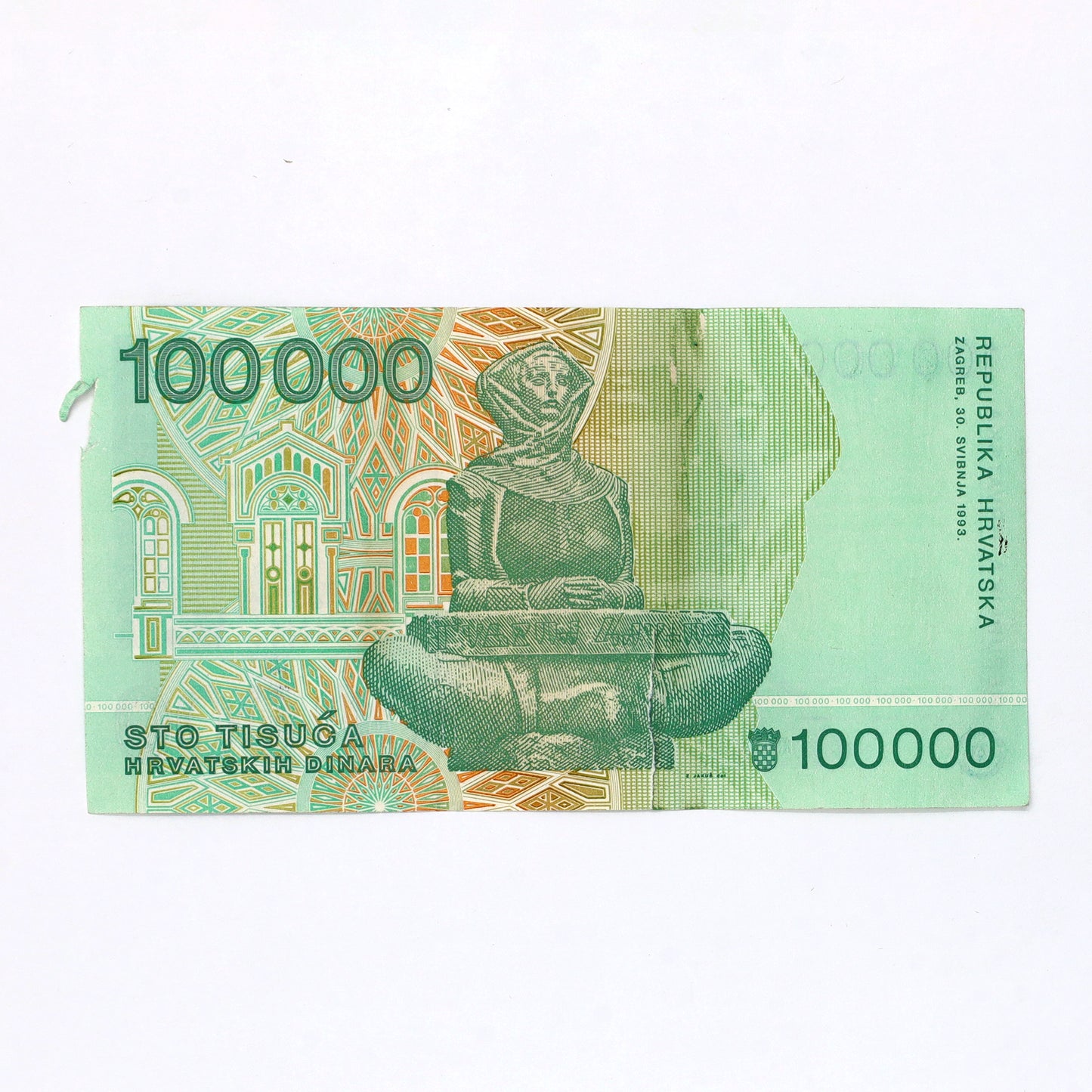
These banknotes feature Ru?er Boškovi? (Roger Boscovich to English speakers), an Enlightenment-era polymath who made large contributions to early astronomy and physics. The statue on the reverse is "Povijest Hrvata" (Mother Croatia), a 1932 work by Ivan Meštrovi?.
Please note, there's a little nick in the edge of the bundle that has resulted in tears in the rear notes. Please see images for details.
The Republic of Croatia borders Slovenia, Hungary, and Serbia on the coast of the Adriatic Sea. The original Croats arrived in the late 6th century, when the area was still largely referred to by the Classical name of Illyria. It became an independent kingdom in 925 with the coronation of Tomislav, but the continuous threat of the Ottoman Empire and rivalry with the Republic of Venice saw it join with the Habsburg monarchy in 1527. It remained tightly bound to Austria and Hungary until after World War I, when it became part of Yugoslavia, before finally declaring its independence in 1991. A fierce War of Independence began, and the new state of Croatia was officially recognized in 1992.
These banknotes feature Ru?er Boškovi? (Roger Boscovich to English speakers), an Enlightenment-era polymath who made large contributions to early astronomy and physics. The statue on the reverse is "Povijest Hrvata" (Mother Croatia), a 1932 work by Ivan Meštrovi?.
Please note, there's a little nick in the edge of the bundle that has resulted in tears in the rear notes. Please see images for details.