

Colonial Acres Coins
SKU: SKU:July.Week1.P2-KB1894
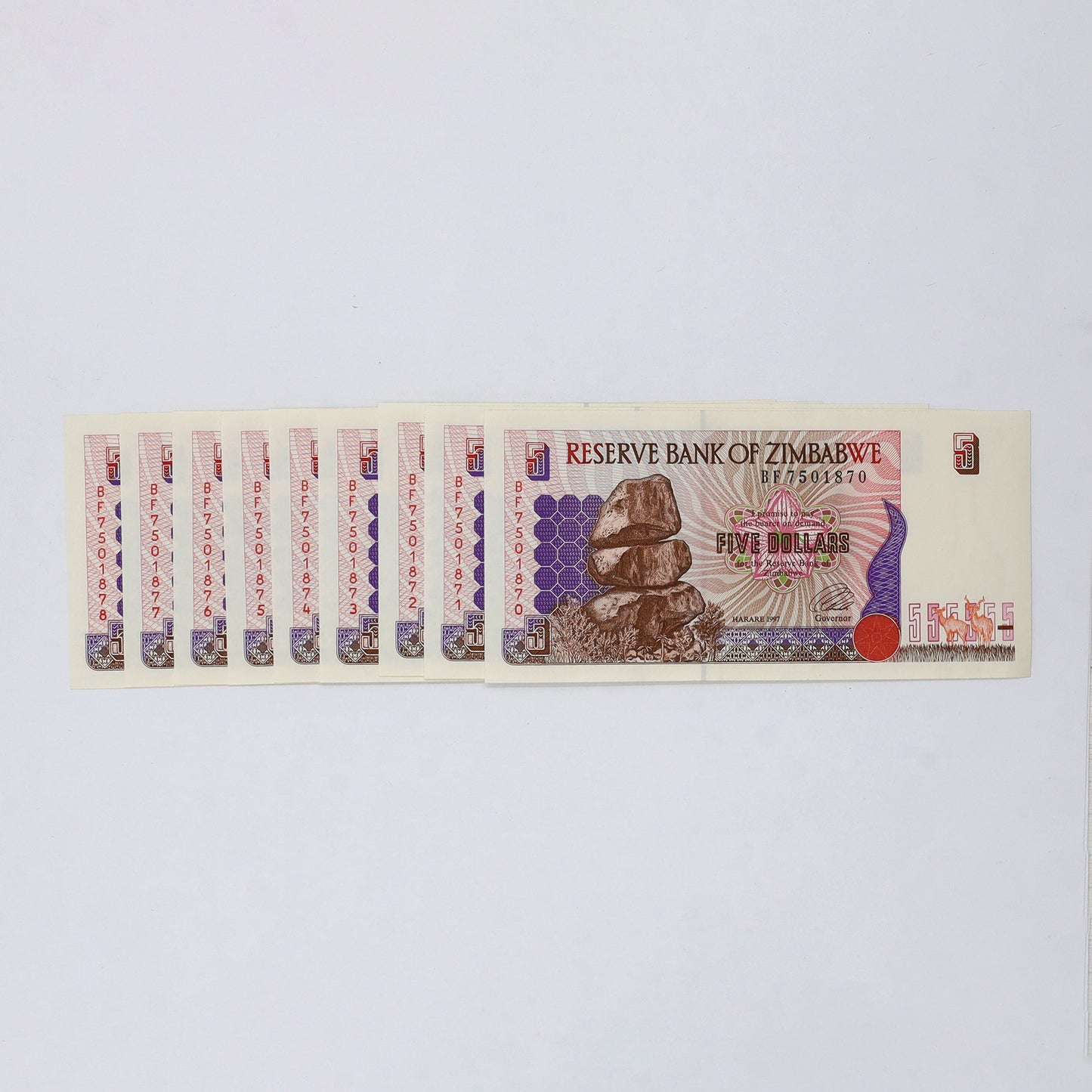
Lot of 9x Consecutive Zimbabwe 1997 $5 Notes, 9pcs
Lot of 9x Consecutive Zimbabwe 1997 $5 Notes, 9pcs
Regular price
$24.95
Regular price
Sale price
$24.95
Unit price
per
We buy at $0.00
Shipping calculated at checkout.
◎ 1 Available
Couldn't load pickup availability

FREE SHIPPING OVER $500
Lot of 9x Consecutive Zimbabwe 1997 $5 Notes, 9pcs
A landlocked country in Southeastern Africa, Zimbabwe borders Botswana, South Africa, Zambia, and Mozambique. Human settlement dates back at least 500,000 years, with the first archaeological discoveries belonging to the San peoples. By the early Middle Ages, trade with Arab states was coalescing Zimbabwe's agrarian communities into a more complex society, and by the 13th century, a series of large trading states had developed. This is perhaps best illustrated by the site of Great Zimbabwe, a sprawling city with multiple districts and 11-metre-high dry stone walls, which eventually became the namesake of the modern country. Zimbabwe was a major economic and trading power in southern Africa until the 1880s, when the British arrived, and an unfortunately familiar story of annexation, subjugation, and exploitation unfolded. Named "Rhodesia" in this period after mining magnate Cecil Rhodes, local resistance was squashed, populations were displaced, and resources were stripped. Most land was given to the white minority, who also controlled the government. Rhodesia declared its independence in 1965, which sparked sanctions, trade embargos, and, eventually, civil war between the minority white establishment and black guerrilla forces backed by Communist powers like the USSR, China, and Cuba. Full independence was not achieved until 1980, when Rhodesia's name was officially changed to Zimbabwe.
These paper notes date to 1997. The obverse features the Chiremba Balancing Rocks in Matopos National Park, one of Zimbabwe's most famous natural features.
A landlocked country in Southeastern Africa, Zimbabwe borders Botswana, South Africa, Zambia, and Mozambique. Human settlement dates back at least 500,000 years, with the first archaeological discoveries belonging to the San peoples. By the early Middle Ages, trade with Arab states was coalescing Zimbabwe's agrarian communities into a more complex society, and by the 13th century, a series of large trading states had developed. This is perhaps best illustrated by the site of Great Zimbabwe, a sprawling city with multiple districts and 11-metre-high dry stone walls, which eventually became the namesake of the modern country. Zimbabwe was a major economic and trading power in southern Africa until the 1880s, when the British arrived, and an unfortunately familiar story of annexation, subjugation, and exploitation unfolded. Named "Rhodesia" in this period after mining magnate Cecil Rhodes, local resistance was squashed, populations were displaced, and resources were stripped. Most land was given to the white minority, who also controlled the government. Rhodesia declared its independence in 1965, which sparked sanctions, trade embargos, and, eventually, civil war between the minority white establishment and black guerrilla forces backed by Communist powers like the USSR, China, and Cuba. Full independence was not achieved until 1980, when Rhodesia's name was officially changed to Zimbabwe.
These paper notes date to 1997. The obverse features the Chiremba Balancing Rocks in Matopos National Park, one of Zimbabwe's most famous natural features.