


Save 5% Off Sale Price! Savings Applied in Cart!
SKU: SKU:xDOD-M150
Ancient Roman Republic 47 BC Julius Caesar Rev. Trinacrus Silver Denarius VF-EF (VF30)
Ancient Roman Republic 47 BC Julius Caesar Rev. Trinacrus Silver Denarius VF-EF (VF30)
Regular price
$594.95
Regular price
$850.00
Sale price
$594.95
Unit price
per
We buy at $0.00
Shipping calculated at checkout.
◎ 1 Available
Couldn't load pickup availability

FREE SHIPPING OVER $500
Ancient Roman Republic 47 BC Julius Caesar Rev. Trinacrus Silver Denarius VF-EF (VF30)
Reformer. Populist. Tactician. General. Dictator. Would-Be King. Julius Caesar's presence looms so large in history, his name is the one that other giants are compared to. Napoleon was like Caesar; Washington was like Caesar; Charlemagne, Hitler, and Genghis Khan were like Caesar. Caesar's impact on history was so massive that his name became synonymous with supreme power: as a title, it outlived the Roman Empire and passed down to the kaisers and tsars and Kayser-i-Rûms of modern Western history. Whatever opinions circulate about his actions, his influence was absolutely titanic.
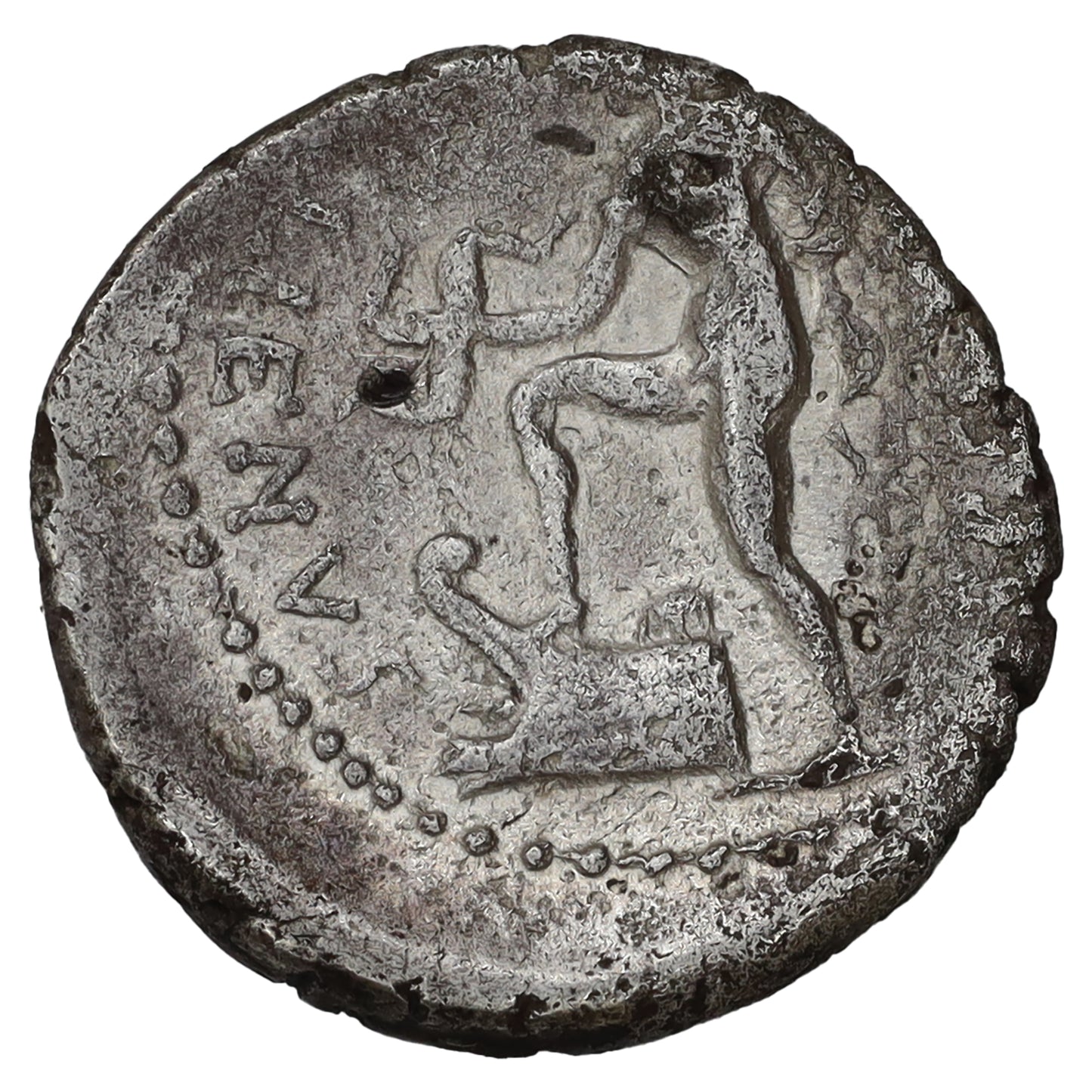
In 47 BCE, Caesar was approaching the pinnacle of his career and the climax of his story. He was 53. He had overcome political enemies, conquered the massive territory of Gaul, and collected military victories across Europe. He had spent the last several years embroiled in a Civil War against his former ally, Gnaeus Pompeius Magnus (Pompey the Great) and, in 48, had been presented with his enemy's head. Forces loyal to Pompey were still gathered in North Africa, however, and Caesar was perched on the island of Sicily, intending to use it as a jumping-off point to cross the sea and finish them off. While he was there, he ordered a small number of coins minted by the Sicilian proconsul Aulus Allienus. These coins show the bust of Venus on the obverse and the figure of Trinacrus, a Sicilian deity, on the reverse. Trinacrus' foot is on the prow of a ship, and he holds a trisceles in his outstretched hand. Struck in extraordinary circumstances, the Trinacrus denarius is one of the rarest of Roman coins, and is associated with a truly monumental period in Western history.
Reformer. Populist. Tactician. General. Dictator. Would-Be King. Julius Caesar's presence looms so large in history, his name is the one that other giants are compared to. Napoleon was like Caesar; Washington was like Caesar; Charlemagne, Hitler, and Genghis Khan were like Caesar. Caesar's impact on history was so massive that his name became synonymous with supreme power: as a title, it outlived the Roman Empire and passed down to the kaisers and tsars and Kayser-i-Rûms of modern Western history. Whatever opinions circulate about his actions, his influence was absolutely titanic.
In 47 BCE, Caesar was approaching the pinnacle of his career and the climax of his story. He was 53. He had overcome political enemies, conquered the massive territory of Gaul, and collected military victories across Europe. He had spent the last several years embroiled in a Civil War against his former ally, Gnaeus Pompeius Magnus (Pompey the Great) and, in 48, had been presented with his enemy's head. Forces loyal to Pompey were still gathered in North Africa, however, and Caesar was perched on the island of Sicily, intending to use it as a jumping-off point to cross the sea and finish them off. While he was there, he ordered a small number of coins minted by the Sicilian proconsul Aulus Allienus. These coins show the bust of Venus on the obverse and the figure of Trinacrus, a Sicilian deity, on the reverse. Trinacrus' foot is on the prow of a ship, and he holds a trisceles in his outstretched hand. Struck in extraordinary circumstances, the Trinacrus denarius is one of the rarest of Roman coins, and is associated with a truly monumental period in Western history.