


Colonial Acres Coins
SKU: SKU:Aug.Week3.P1-KB2321
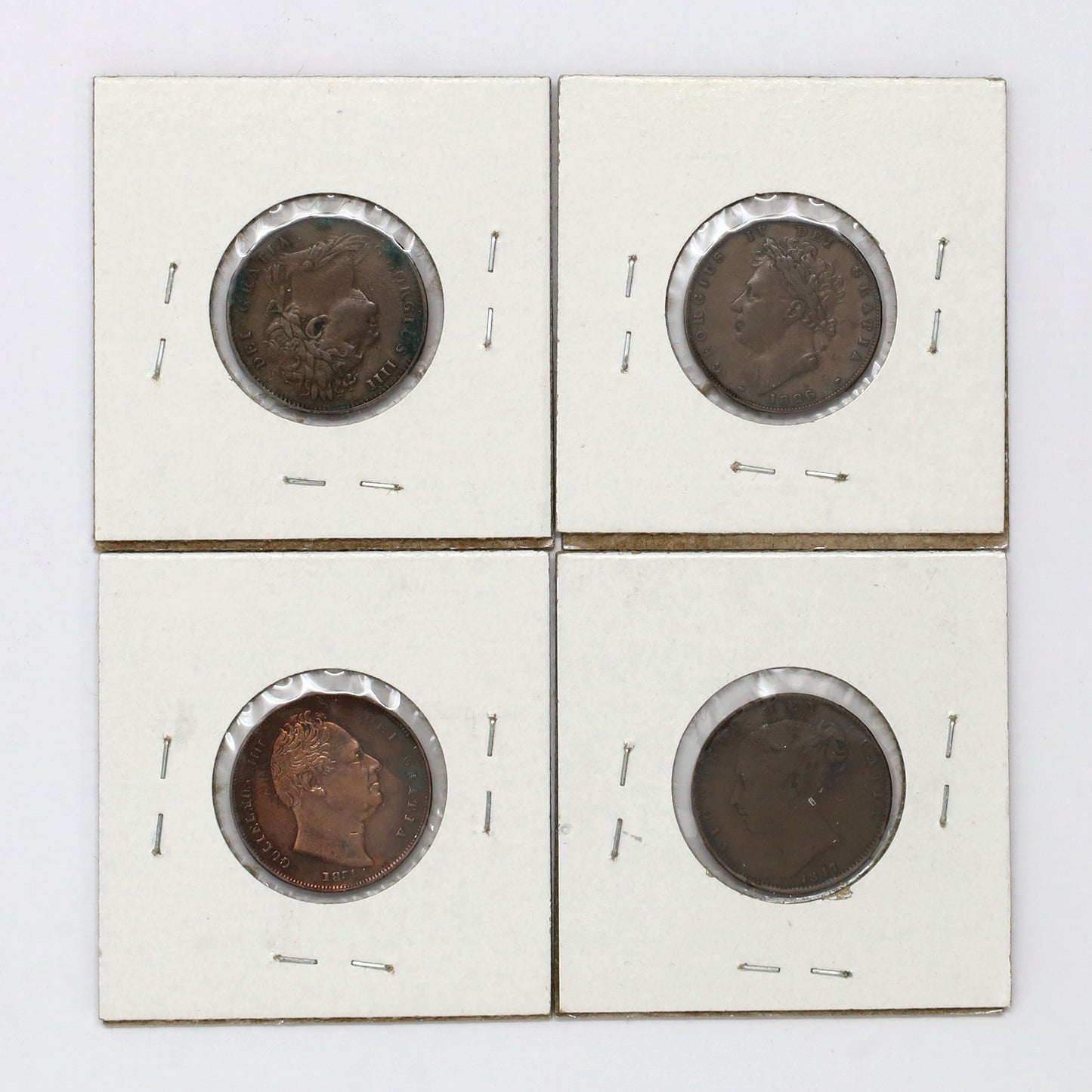
Lot of 4x Great Britain 1823-1847 Farthings VG-F to Extra Fine, 4pcs
Lot of 4x Great Britain 1823-1847 Farthings VG-F to Extra Fine, 4pcs
Regular price
$19.95
Regular price
Sale price
$19.95
Unit price
per
We buy at $0.00
Shipping calculated at checkout.
◎ 1 Available
Couldn't load pickup availability

FREE SHIPPING OVER $500
Lot of 4x Great Britain 1823-1847 Farthings VG-F to Extra Fine, 4pcs
Take a trip through time with four historical British farthings! You will receive:
At the same time, the world was industrializing, and Britain was no exception. People were flocking from the country to factory work in the cities, and this came with its own fresh set of challenges. Cities were not built to hold the populations they now contained. Overcrowded slums grew, and crime, addiction, and infectious diseases such as typhoid and cholera became epidemics. The importance of safe working conditions was not yet understood; people, including children, worked 16-hour shifts in dark, poorly ventilated spaces, with open machinery that could maim or kill. Overseas, colonial oppression was at its most brutal. The Empire was expanding into India, China, and Africa, annexing land, stripping resources, displacing populations, and brutally suppressing resistance. Everywhere, human suffering became the acceptable cost of commercial profit.
But it wasn't all bad. The slave trade was finally abolished in 1833, and the Royal Navy began policing the ocean for pirates and slavers, which benefited everyone. Social reform began picking up steam as populations outgrew the patchwork laws that had served them for centuries, leading to universal benefits like the abolishment of the death penalty for all but the most serious crimes and the establishment of the first professional police force, with a focus on crime prevention. (They still exist -- the London Metropolitan Police, AKA the Bobbies.) With safe seas, the Royal Geographical Society began coordinating and funding expeditions that were purely exploratory in nature. Discoveries made on South American coasts, West African rivers, the Arctic Circle and beyond would shape the fields of biology, geography, anthropology, and more. This was not only the start of the Victorian period; it was, in so many ways, the era that shaped both the good and the bad in the modern world we know today.
Take a trip through time with four historical British farthings! You will receive:
- 1823 George IV F-VF (Impaired)
- 1826 George IV VG-F
- 1831 William IV Extra Fine (Cleaned)
- 1847 Victoria F-VF
At the same time, the world was industrializing, and Britain was no exception. People were flocking from the country to factory work in the cities, and this came with its own fresh set of challenges. Cities were not built to hold the populations they now contained. Overcrowded slums grew, and crime, addiction, and infectious diseases such as typhoid and cholera became epidemics. The importance of safe working conditions was not yet understood; people, including children, worked 16-hour shifts in dark, poorly ventilated spaces, with open machinery that could maim or kill. Overseas, colonial oppression was at its most brutal. The Empire was expanding into India, China, and Africa, annexing land, stripping resources, displacing populations, and brutally suppressing resistance. Everywhere, human suffering became the acceptable cost of commercial profit.
But it wasn't all bad. The slave trade was finally abolished in 1833, and the Royal Navy began policing the ocean for pirates and slavers, which benefited everyone. Social reform began picking up steam as populations outgrew the patchwork laws that had served them for centuries, leading to universal benefits like the abolishment of the death penalty for all but the most serious crimes and the establishment of the first professional police force, with a focus on crime prevention. (They still exist -- the London Metropolitan Police, AKA the Bobbies.) With safe seas, the Royal Geographical Society began coordinating and funding expeditions that were purely exploratory in nature. Discoveries made on South American coasts, West African rivers, the Arctic Circle and beyond would shape the fields of biology, geography, anthropology, and more. This was not only the start of the Victorian period; it was, in so many ways, the era that shaped both the good and the bad in the modern world we know today.