


Colonial Acres Coins
SKU: SKU:June.Week3.P3-KB1165
Late Roman Empire 364-378AD Valens Gold Solidus VF-EF (Graffiti)
Late Roman Empire 364-378AD Valens Gold Solidus VF-EF (Graffiti)
Regular price
$1,449.95
Regular price
$1,650.00
Sale price
$1,449.95
Unit price
per
We buy at $0.00
Shipping calculated at checkout.
◎ 1 Available
Couldn't load pickup availability

FREE SHIPPING OVER $500
Late Roman Empire 364-378AD Valens Gold Solidus VF-EF (Graffiti)
RESTITVTOR REIPVBLICAE
This is the title Valens (328-378) chose for himself when his brother, Valentinian I, named him co-emperor and gave him the eastern half of the Roman Empire to rule. Translating to "Restorer of the Republic," Valens, who came to power in an unstable Rome that was well past its prime, was positioning himself as the Empire's saviour; a stabilizing force that would breathe new life into a declining civilization. Ironically, his reign is mostly remembered for marking the opposite.
In the late fourth century, a major threat was rising in the east. These were the Huns: a fierce, nomadic people whose unmatched skill at horseback archery was quickly winning them a large pocket of Central Asia. While the Huns themselves wouldn't reach Rome for some years, their violence drove local tribes west, causing a wave of migration that led to the Goths and Alans spilling over Rome's eastern border. Valens initially reacted empathetically, allowing some of the refugees through to settle in the Balkans. Soon, however, the flood of newcomers was too much for Rome to absorb, and violence broke out on both sides. This crescendoed at the Battle of Adrianople, where Valens and the Eastern Roman army faced off against Gothic rebels led by Fritigern. Rome suffered an absolutely humiliating defeat, stripping the Eastern Empire of most of its key administrators, generals, two-thirds of its army -- and its emperor. Valens himself fell anonymously at Adrianople, abandoned by his guard, his body left amongst the carnage. This defeat marked the start of Rome's final decline into division and collapse.
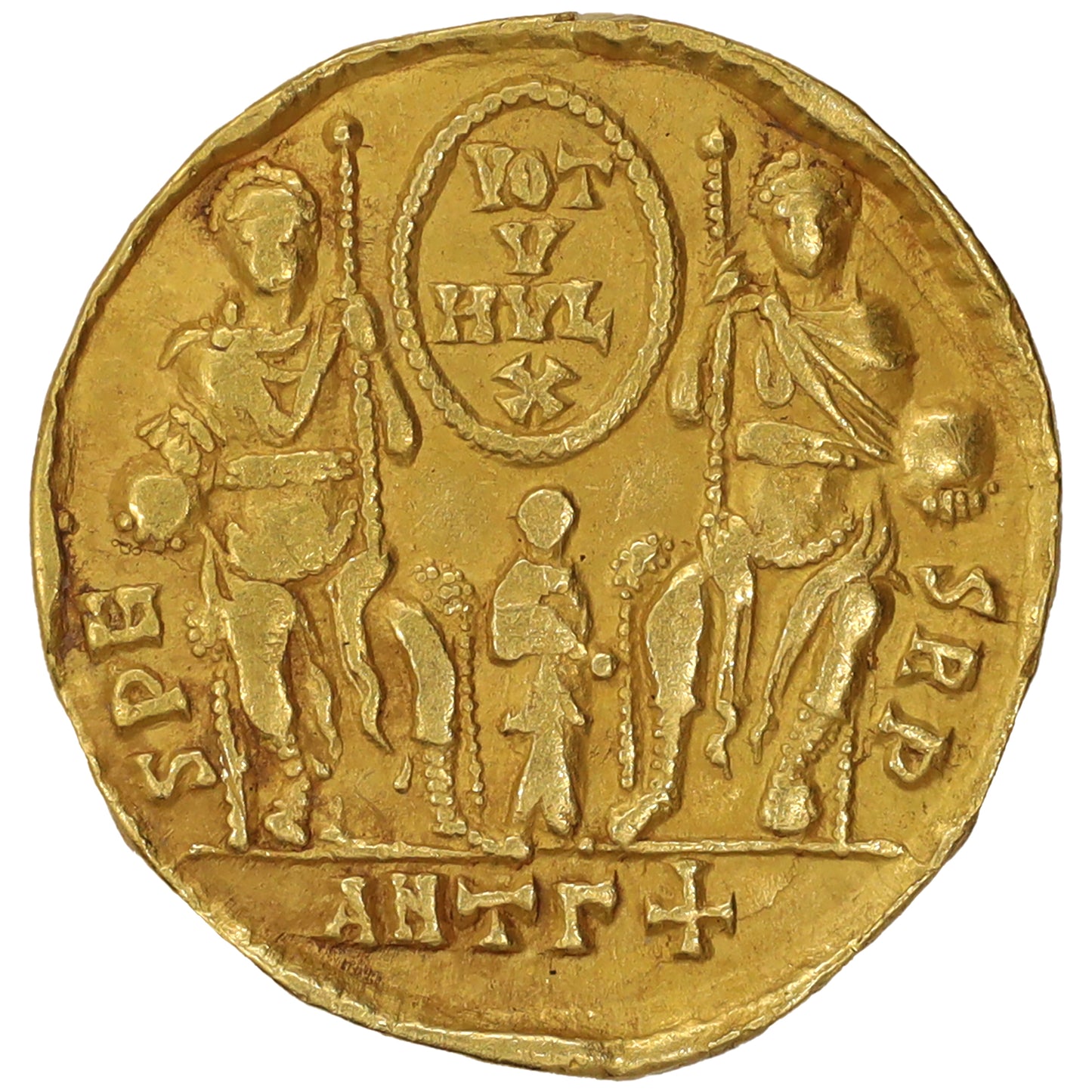
Now you can own a shining piece of this fascinating and tumultuous period in Classical history. This stunning gold solidus features the bust of Valens on the obverse, heavily featured, draped, and wearing a pearl diadem. The reverse shows Valens and his co-emperor, Valentinian, seated on thrones in military dress, each holding a sceptre and globus cruciger. Between them is the small figure of Valentinian's son and eventual successor, Gratian.
RESTITVTOR REIPVBLICAE
This is the title Valens (328-378) chose for himself when his brother, Valentinian I, named him co-emperor and gave him the eastern half of the Roman Empire to rule. Translating to "Restorer of the Republic," Valens, who came to power in an unstable Rome that was well past its prime, was positioning himself as the Empire's saviour; a stabilizing force that would breathe new life into a declining civilization. Ironically, his reign is mostly remembered for marking the opposite.
In the late fourth century, a major threat was rising in the east. These were the Huns: a fierce, nomadic people whose unmatched skill at horseback archery was quickly winning them a large pocket of Central Asia. While the Huns themselves wouldn't reach Rome for some years, their violence drove local tribes west, causing a wave of migration that led to the Goths and Alans spilling over Rome's eastern border. Valens initially reacted empathetically, allowing some of the refugees through to settle in the Balkans. Soon, however, the flood of newcomers was too much for Rome to absorb, and violence broke out on both sides. This crescendoed at the Battle of Adrianople, where Valens and the Eastern Roman army faced off against Gothic rebels led by Fritigern. Rome suffered an absolutely humiliating defeat, stripping the Eastern Empire of most of its key administrators, generals, two-thirds of its army -- and its emperor. Valens himself fell anonymously at Adrianople, abandoned by his guard, his body left amongst the carnage. This defeat marked the start of Rome's final decline into division and collapse.
Now you can own a shining piece of this fascinating and tumultuous period in Classical history. This stunning gold solidus features the bust of Valens on the obverse, heavily featured, draped, and wearing a pearl diadem. The reverse shows Valens and his co-emperor, Valentinian, seated on thrones in military dress, each holding a sceptre and globus cruciger. Between them is the small figure of Valentinian's son and eventual successor, Gratian.